Build an annual RV operating-cost budget
Organize storage, upkeep, and travel costs without relying on a fictional national average.
Specs and limits
This is a storage, upkeep, and operating-cost worksheet, not a national price estimate. Use your own quotes, invoices, planned mileage, and booking costs. Purchase price, financing, insurance, taxes, and resale forecasting are outside this guide’s scope.
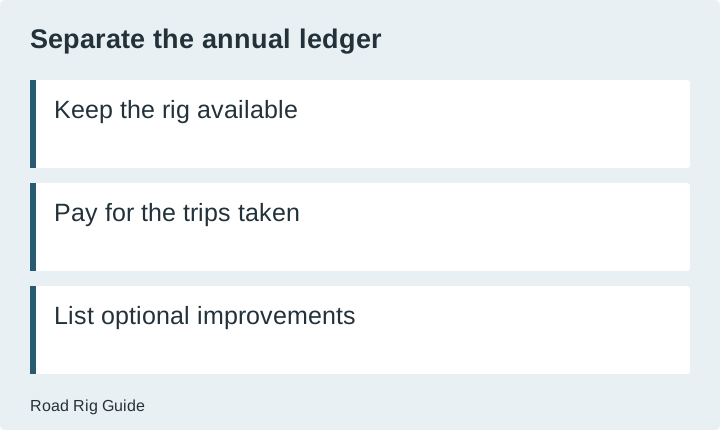
An annual RV budget is easier to understand when it answers two separate questions: what it costs to keep the rig available, and what changes when you take another trip. Mixing everything into a single cost-per-night figure can hide a storage bill that continues even when the RV never leaves home. Start with the categories, then supply evidence for the amounts.
This guide deliberately does not provide a “typical annual cost.” The size, age, equipment, location, storage arrangement, and use of an RV can differ substantially. A precise-looking average would not tell you what your own storage provider charges or which service your actual equipment needs next.
Separate ownership readiness from travel activity
Readiness costs are the expenses associated with keeping the rig in your chosen condition and storage arrangement. They can include paid storage, scheduled service, inspection appointments, and seasonal preparation. Some are recurring bills; others occur only when a task becomes due. Record the basis for each amount rather than treating every line as monthly.
Travel activity adds costs such as driving fuel and campsite nights. Those depend on your itinerary and use. A longer route may change fuel while leaving the storage contract unchanged. An extra campsite night can change lodging without changing the round-trip distance. Keeping these relationships visible makes scenario comparisons more useful.
Create a separate list of optional improvements. A replacement required to restore a function is different from an upgrade chosen for convenience. Both may require cash, but combining them makes it difficult to understand whether the rig’s ordinary operation is becoming more expensive or you are choosing additional features.
Start with records you can obtain
For storage, request the current written terms for the actual space you intend to use. Check whether the amount is monthly, seasonal, or annual, and what access or services are included. Record any separate charges and the period covered. Do not assume a quoted price for a smaller space applies to your complete rig.
For service, use the equipment’s maintenance schedule and actual provider estimates. Airstream’s published maintenance guidance shows an example of time- and mileage-based tasks. It is not a price list and should not be substituted for another RV’s manual. Ask the relevant provider what the requested service includes.
For travel, collect your planned miles, paid nights, and known booking totals. FuelEconomy.gov explains that load and driving conditions affect consumption. Use measured comparable mileage where available, or make assumptions explicit. Do not turn an advertised vehicle rating into an unqualified towing forecast.
Build the ledger before calculating a total
| Category | Amount basis | Evidence | What changes the total? | | --- | --- | --- | --- | | Storage | Monthly or contract-period charge | Current provider terms | Space, location, contract and services | | Scheduled upkeep | Task cost when due | Correct manual plus current quote | Time, mileage, equipment and condition | | Seasonal preparation | Actual scope and frequency | Service quote or documented materials | Climate, storage method and installed systems | | Driving fuel | Miles divided by MPG, multiplied by price | Trip assumptions or fuel records | Route, use, consumption and price | | Campsites | Actual nights and rates | Booking totals or dated quotes | Dates, site selection and fees | | Optional improvements | Separate chosen project | Defined specification and quote | Your decision to add the feature |
Add columns for amount, date obtained, and confidence. A confirmed invoice, a current estimate, and a number borrowed from someone else’s trip do not carry the same evidential weight. Leaving a number unresolved is preferable to concealing the uncertainty inside a polished total.
Use an illustrative annual scenario
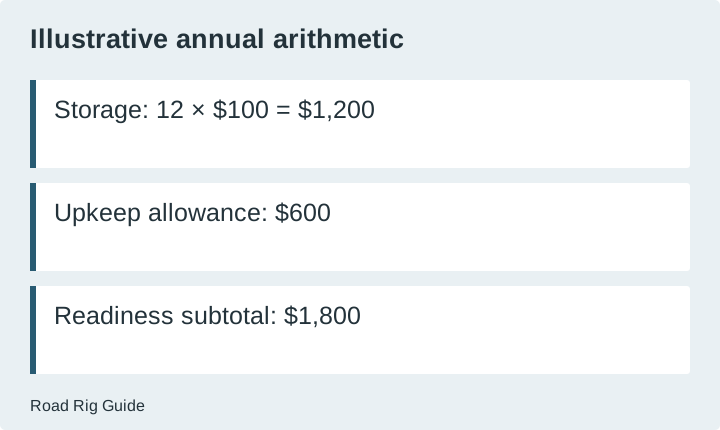
Suppose, solely to demonstrate the arithmetic, a storage arrangement costs $100 per month. Twelve months would be $1,200. Suppose your planned service allowances total $600 for the year. Those two entries make a $1,800 readiness subtotal. None of these numbers is an observed price or a recommendation for the amount your rig needs.
Now assume six identical example trips, each costing $529.20 for fuel and campsites using the worked example in the trip-budget tool. Multiplying by six gives $3,175.20. Adding that to the illustrative readiness subtotal gives $4,975.20 for the categories entered. It is not an all-in annual ownership cost because excluded or unentered categories remain outside it.
The example is useful because its pieces can change independently. Four such trips would reduce the modeled travel subtotal, but would not automatically reduce twelve months of storage. A different contract or a decision to stop using paid storage is a separate change that needs its own assumptions.
Treat replacement planning as a schedule
Some items may not be replaced every year. Record what is known about their condition, the relevant manufacturer guidance, and the expected decision point. Do not manufacture an exact replacement date from age alone. If you choose to set money aside, label that as a personal reserve rather than an expense already incurred.
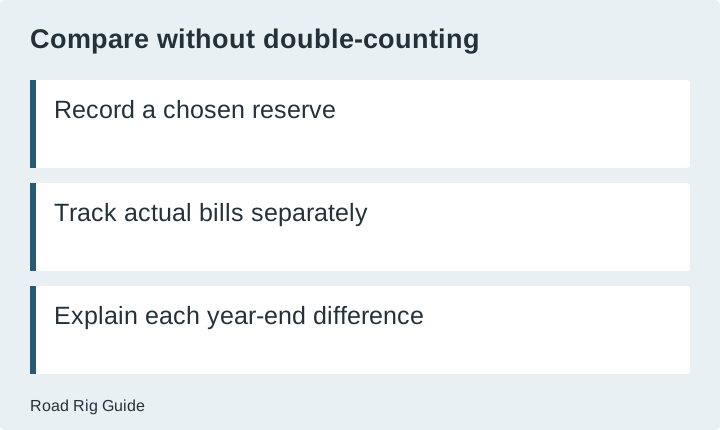
Keep reserve contributions and actual spending in separate columns. Otherwise, you can count the same replacement twice: once when setting money aside and again when paying the bill. The purpose of the reserve is to help plan cash availability; it does not predict which part will fail or eliminate the need for inspection.
Avoid assigning repair estimates without an assessment. An unexplained symptom may have several causes. Obtain a defined scope before comparing quotes, and ask whether diagnosis, parts, labor, transport, and follow-up are included. This guide does not provide mechanical, electrical, gas, or brake repair procedures.
Compare a busy year with a quiet year
Make two copies of the ledger and change the usage inputs. In the quiet-year version, reduce trips and mileage while keeping contract costs consistent. Review whether lower mileage changes any scheduled tasks, but retain time-based obligations unless the actual manual says otherwise. A parked rig is not automatically cost-free.
In the busy-year version, increase the trips you genuinely expect to take and identify which service intervals may become due. Use the same price basis for both scenarios unless the comparison is specifically about a price change. Changing frequency, fuel price, and service scope at once makes the result harder to interpret.
Add a short note explaining each difference. The useful output is understanding which decisions you control and which costs remain even with less travel. A single annual total should be the result of that reasoning, not a substitute for it.
Close the year with comparable categories
As invoices arrive, place actual spending beside the original estimate. Explain differences by category: more nights, longer driving, a changed storage arrangement, additional service, or a chosen improvement. Preserve the original assumptions so you can distinguish planning errors from decisions made later.
Carry verified recurring information into the next year and refresh changing quotes. Keep a clear list of excluded categories, especially when sharing the budget with someone else. The worksheet becomes valuable when it represents your actual rig and plans, with uncertainty visible, rather than when every cell has a number.
Sources
- Airstream: regular maintenance schedule
Accessed 2026-11-20. Check the source for equipment-specific instructions and current policies. - DOE/EPA: factors affecting fuel economy
Accessed 2026-11-20. Check the source for equipment-specific instructions and current policies.