Travel trailer, fifth wheel or motorhome?
Compare the whole travel routine before choosing an RV type.
Specs and limits
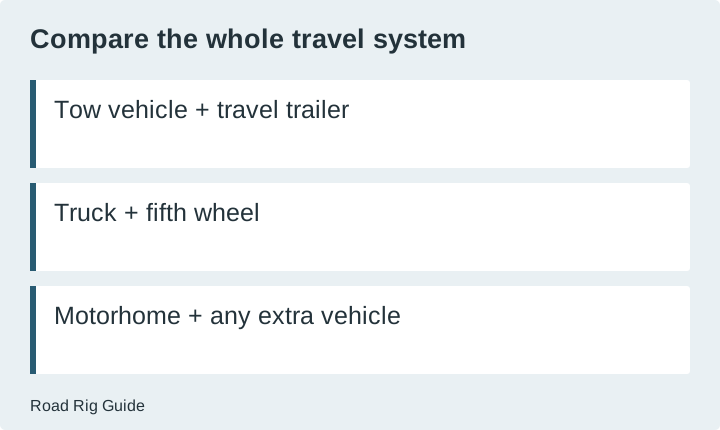
Compare the complete travel combination: tow vehicle and trailer, or motorhome and any additional vehicle. Record actual dimensions, travel seats, loaded weights, storage arrangements, and equipment ratings. No RV class guarantees a suitable payload or campsite fit.
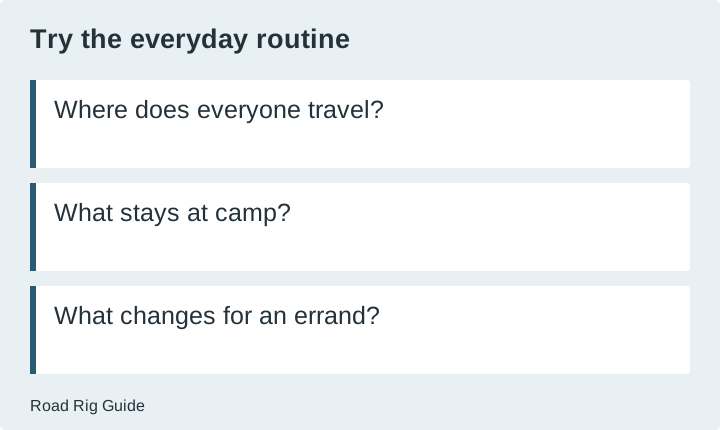
Imagine an ordinary stop on the trip you actually want to take. You arrive, put the rig in its site, make dinner, and decide whether to drive somewhere the next morning. Which vehicle moves? What must be packed away? Where does everyone sit while traveling? Those questions usually reveal more than deciding which RV category looks most impressive in a photograph.
A travel trailer, fifth wheel, and motorhome organize transport and accommodation differently. The comparison below is a planning exercise, not a road test or a ranking of models. Use it to narrow the category, then inspect actual floor plans and ratings. A category cannot tell you whether a particular unit works for your passengers, storage space, or preferred routes.
Compare the complete system
A conventional travel trailer needs a suitable tow vehicle and connection. A fifth wheel uses a different coupling arrangement and places different demands on the tow vehicle. A motorhome contains its own driving system, but that does not settle how you will handle errands after setting up camp. If you plan to bring a separate vehicle, include that additional equipment and its limitations in the comparison.
Winnebago’s overview of RV types is a useful starting point for category vocabulary. Keep manufacturer descriptions separate from your own suitability assessment. A model described as compact or spacious still needs to be measured against your parking space and daily routine.
Create one sheet per candidate combination. Put the exact model year and floor plan at the top, and list the transport, living, and storage pieces below. Do not compare a fully equipped motorhome with the trailer’s sticker alone while ignoring a necessary tow-vehicle change. The physical system should be complete before its costs or convenience are compared.
Ask what stays at camp
If you tend to establish a base and leave for daytime activities, think through the departure process from that base. Which belongings stay behind? Does leaving require changing the bed, stowing countertop items, or disconnecting equipment? What happens if one person wants to remain at the campsite while another goes out?
If you instead move frequently, count the tasks repeated each morning. A task that is easy once may feel different when repeated through several travel days. Write down the sequence rather than relying on a vague impression that one type is easier. Ask the seller to demonstrate the normal setup and departure routine for the exact unit.
Neither pattern makes a category universally superior. A couple who values a small moving footprint may willingly rearrange living space. Another household may prefer leaving its accommodation in place. Your worksheet should identify the tradeoff you are choosing, not attempt to erase it with an overall score.
Use a comparison table you can complete
| Question | Travel trailer | Fifth wheel | Motorhome | | --- | --- | --- | --- | | What provides transport? | Record the proposed tow vehicle | Record the proposed truck and coupling | Record the motorhome and any extra vehicle | | What is the whole travel footprint? | Measure the combination | Measure the combination | Include anything carried or towed | | Where do people travel? | Verify designated vehicle seats | Verify designated vehicle seats | Verify approved travel seats, not bed count | | What changes for a grocery stop? | Describe parking and access | Describe parking and access | Describe what must be packed away | | What fits at home? | Check storage and maneuvering | Check storage and maneuvering | Check height, length, access and restrictions |
The table deliberately asks for records instead of supplying category averages. Averages can conceal the exact feature that matters to you, such as a bed that requires climbing over another sleeper or a storage door that cannot open in a narrow parking space.
Check the connection before the floor plan wins
For a towable, the hitch is part of a chain of compatible components. CURT’s hitch-type guide distinguishes receiver, weight-distributing, fifth-wheel, and other arrangements. That vocabulary helps you ask the right questions, but it does not approve a particular vehicle and trailer pairing.
Obtain the vehicle-specific trailer limit, payload allowance, axle ratings, and hitch limits before treating the combination as a candidate. A desirable floor plan is not a reason to work backward from an optimistic loading assumption. If the correct configuration cannot be documented, put it in the unresolved column instead of accepting a generic maximum from an advertisement.
For a motorhome, make an equally explicit list of people, water, supplies, and accessories. Self-propelled accommodation still has load limits. If an additional vehicle will be towed, verify that complete arrangement separately. None of the categories gets an exemption from equipment-specific documentation.
Try a rainy afternoon indoors
Walk through ordinary activities with everyone who will use the rig. Sit where you expect to eat, reach the storage you need, and check how people pass one another. If a bed converts from seating, practice the change with permission. Think about where wet coats, shoes, and the day’s bags go without blocking circulation.
Ask to see the interior in its travel configuration as well as its camping configuration. A beautiful open layout may depend on a mechanism being extended. Decide whether the items you want during a stop remain accessible when everything is stowed. Record observations instead of relying on memory after visiting several units.
Make separate notes for inconvenience and impossibility. A task that takes a little longer may be acceptable. A required travel seat that does not exist is a different problem. Keeping those categories apart prevents an attractive cosmetic feature from outweighing a basic requirement.
Price your actual pattern of use
Use the trip-budget worksheet with your own distance, fuel-economy assumption, and campsite rates. It does not supply fuel economy by RV class. Run the same planned trip through each candidate using documented or explicitly hypothetical inputs, and keep uncertainty visible.
Add storage and upkeep planning outside that trip total. Ask where the complete combination will be kept, who can service it, and which tasks require appointments or transport. This guide does not cover financing or insurance; it focuses on the operational decisions that make a rig practical to use.
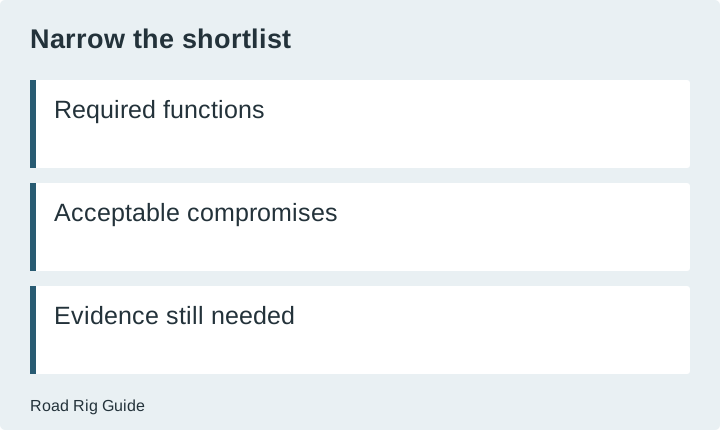
Finish with a short list of non-negotiable needs, acceptable compromises, and missing evidence. Choose the next inspection or demonstration that resolves the largest unknown. The right category is the one that supports your real travel routine within verified constraints, not the one that wins every imagined scenario.
Sources
- Winnebago: RV basics
Accessed 2026-11-20. Check the source for equipment-specific instructions and current policies. - CURT: types of trailer hitches
Accessed 2026-11-20. Check the source for equipment-specific instructions and current policies.