National forest, state park or private campground?
Compare the actual site and operating rules, not just the label over the entrance.
Specs and limits
A land-management or ownership category does not guarantee hookups, access, availability, or a particular price. Check the individual facility, site number, travel dates, rig dimensions, and current operating rules before booking or driving in.
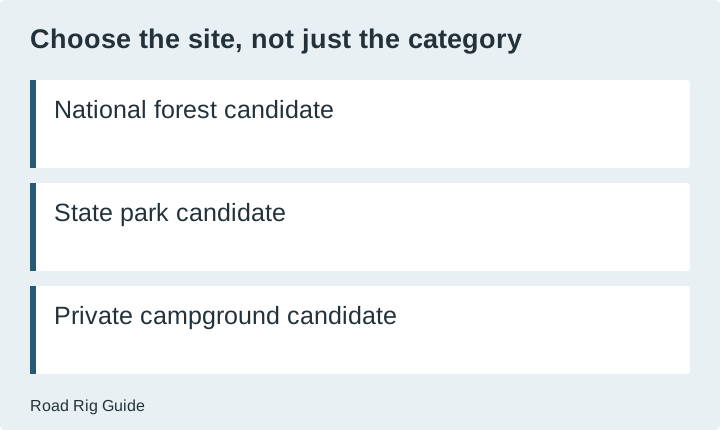
The most useful campground comparison starts with a specific night on your itinerary. You need a place the rig can reach, a site it can use, and services that match your plan. A national forest campground, a state park, and a private campground may each meet those needs, but the name over the entrance does not answer the details.
Instead of ranking the three categories, build a shortlist of actual facilities. Compare the same dates and the same requirements. This makes it easier to see whether an attractive location lacks an essential service or whether a seemingly expensive option includes something you would otherwise arrange separately.
Separate the operator from the experience
Public land and campground operations are not interchangeable concepts. Identify who manages the land, who operates the facility, and where the current rules are published. The booking page and the land manager’s page may answer different questions. Keep both when they are relevant, especially if seasonal access or restrictions affect the trip.
A private campground also needs a facility-specific check. Read its own terms rather than assuming it follows a public reservation system’s policy. Ask about the exact site class, arrival procedure, and any restrictions that matter to your equipment or household. A general amenities list may describe the property without guaranteeing every feature at every site.
The practical question is not whether one category is more authentic. It is whether the specific place supports the way you intend to camp. A simple site may be ideal for one night and unsuitable for another part of the same trip. You can choose different types for different needs without treating that as an inconsistent plan.
Write your non-negotiables first
List the complete rig dimensions, the number of people and vehicles, and the services your plan depends on. Decide which needs are essential and which are preferences. If you need a particular electrical service, reliable access, or a permitted arrival time, treat confirmation of that feature as a requirement rather than a hopeful assumption.
Include how you expect to spend time at the campground. Proximity to facilities, quiet, shade, and room to sit outside may matter differently on a long stay than on an overnight stop. Use descriptions and site information to identify candidates, then resolve important ambiguities with the operator.
The National Park Service’s campsite-selection guidance emphasizes checking facilities and regulations before arrival. Its advice is a useful question list, not evidence that a particular national forest, state park, or private site has those facilities. Apply the questions to each actual listing.
Compare like-for-like information
| Decision | National forest candidate | State park candidate | Private candidate | | --- | --- | --- | --- | | Booking | Record exact operator and reservation method | Record the park’s current booking rule | Record the property’s own terms | | Access | Verify approach and seasonal conditions | Verify park and campground approach | Verify arrival route and gate arrangements | | Site fit | Check the selected site, not just campground maximum | Check selected site dimensions and layout | Confirm the booked site class and rig fit | | Services | Record what is available on your dates | Record site-level hookups and shared services | Separate included services from optional charges | | Total price | Include applicable extra charges | Include applicable entry or booking charges | Include the complete quoted stay total | | Backup | Identify a lawful, suitable alternative | Identify a lawful, suitable alternative | Check late-arrival and cancellation options |
This table is an original planning framework. It does not claim a service or fee is standard within any category. If a cell cannot be completed from the listing, that missing answer becomes a concrete question for the operator.
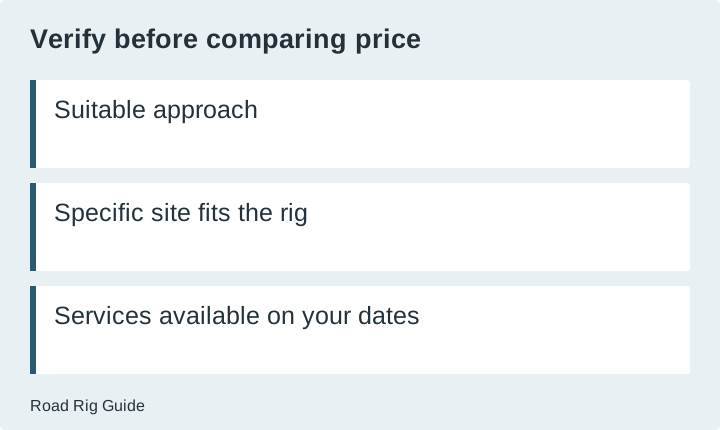
Read the site description closely
A campground may accommodate RVs while a particular site does not fit your combination. Check how the listing defines length, whether it refers to the RV alone or the whole combination, and whether parking for an additional vehicle is available. Do not infer maneuvering room from a single dimension.
Look for information about the parking surface, entry direction, clearance, and the space needed for normal use of your rig. Photographs can help orient you, but they may be old or taken from an angle that conceals an obstacle. A photo should not override a stated restriction or replace an answer about an essential dimension.
Record any assumptions about arrival. If your plan depends on reaching a staff member, using a service point, or entering after a gate closes, confirm the procedure. A reservation establishes something specific; it does not automatically establish unrestricted access at any hour.
Distinguish developed camping from dispersed camping
A developed campground and an undeveloped overnight location involve different planning questions. BLM’s camping guidance distinguishes developed facilities from dispersed camping and notes local variations in services and restrictions. Do not generalize its rules to land managed by another agency or to a privately owned parcel.
If you are considering a dispersed option as a backup, verify the exact place independently. A vacant clearing on a map is not a substitute for a suitable reserved site. Confirm permission, vehicle access, current restrictions, and how you will meet the needs normally supported by campground services.
This guide’s comparison concerns actual camping options, not a promise that public land always provides a free alternative. Keep a backup plan that is lawful, reachable, and appropriate for the rig. A cheaper-looking point on a screen is not useful if the key facts are unknown.
Compare total stay cost, then convenience
Use the complete stay amount when it is available. Separate nightly charges from booking, entrance, extra-vehicle, or other applicable charges. Do not invent a standard fee to fill a blank. If a charge is unclear, ask before treating the lower displayed rate as a saving.
Use the trip-budget calculator to combine campsite and fuel assumptions. A less expensive site farther from your route may add driving. Compare that extra fuel with the difference in the stay total, while keeping convenience and suitability as separate factors.
For mixed nightly rates, use a weighted average: total campsite charges divided by the matching nights. Keep fees that are not part of that average in the other-costs field. The calculation does not assess the campground or verify any quoted amount; it simply makes your own inputs comparable.
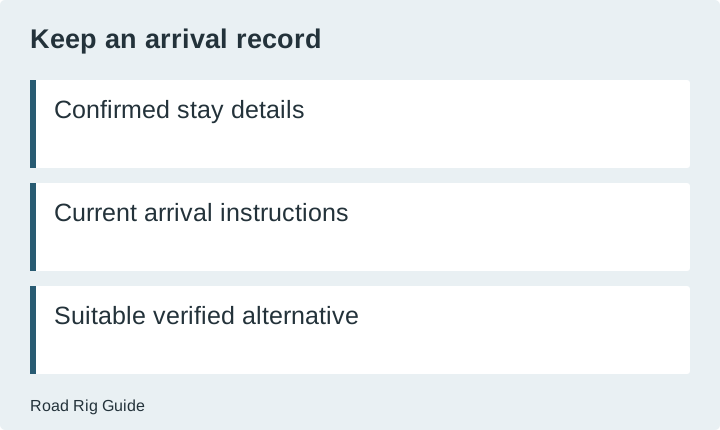
Keep a compact arrival record
Save the facility name, booking details, site information, operator instructions, and contact method where you can access them without relying on a fresh search. Include the current access guidance and a suitable backup. Keep personal booking information private rather than publishing it in shared planning notes.
Before departure, revisit changing information such as closures, operating dates, and arrival arrangements. On arrival, follow the current posted instructions and resolve a mismatch with the operator. The best comparison is one that leads to a usable plan on the day you travel, not merely an appealing list of campground categories.
Sources
- NPS: finding and setting up a campsite
Accessed 2026-11-20. Check the source for equipment-specific instructions and current policies. - BLM: camping on public lands
Accessed 2026-11-20. Check the source for equipment-specific instructions and current policies.