Plan your first week-long RV trip
Build an itinerary around arrival, setup, and departure as well as the drive.
Specs and limits
Build the itinerary from confirmed overnight options, actual rig dimensions, realistic travel tasks, and current route information. A map’s driving time excludes many RV-specific stops and setup tasks. This guide does not verify live availability or route clearance.
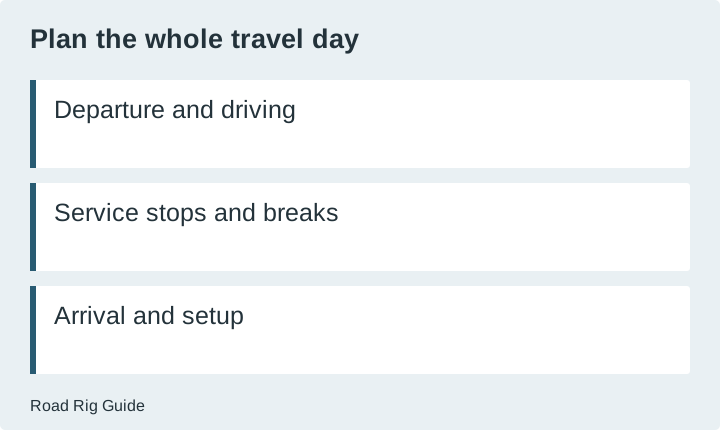
For a first week-long RV trip, begin with the arrival you want to have. You need time to find the correct site, understand the operator’s instructions, and set up the rig without turning the last part of the day into a rush. Work backward from that arrival rather than filling the week with the maximum number of destinations.
A useful first itinerary leaves room to learn what takes time. That does not require a universal mileage limit or a prescribed number of stops. It requires an honest list of the tasks your group and equipment need, plus a fallback when the day does not unfold as expected.
Decide what kind of week you want
Choose between a base-oriented trip, a moving route, or a deliberate combination. A base-oriented plan lets you learn the setup at fewer locations. A moving plan provides more changes of place but repeats arrival and departure work. Neither is inherently better; they ask for different amounts of coordination.
Write down the main reason for the trip and a small set of priorities. Distinguish the activity you care about from places that merely look convenient on the map. This helps you remove a stop that adds complexity without serving the purpose of the week.
Include everyone’s practical needs in the discussion. Travel seats, sleeping arrangements, access to facilities, and time outside the vehicle are not details to resolve after booking. Match the plan to the actual people and rig rather than to an imaginary household with unlimited flexibility.
Count nights before counting attractions
Put each overnight stay on a simple calendar. Confirm whether the trip includes nights near home, transit stops, or a different return route. A week on the calendar does not automatically mean seven paid campsite nights; use the actual arrival and departure dates.
For every planned stop, identify a site that fits the equipment and the current booking process. The NPS campsite-selection guide provides useful facility and regulation questions. Apply them to the exact location rather than assuming one campground’s services are standard elsewhere.
Keep the confirmation status visible. Proposed, requested, and confirmed are different states. Do not let a route diagram make an unbooked night look settled. If a key stop is unavailable, revise the sequence before adding more dependent reservations.
Build the day around tasks
List departure preparation, driving, fuel or service stops, breaks, arrival, and setup separately. Use your own experience where available and allow room for unfamiliar tasks. Do not translate a car-navigation estimate directly into the complete day’s duration.
Ask what must be ready before the vehicle moves and what can wait until after arrival. A packing task that blocks the doorway or a service stop that closes early may affect the order of the day. Make those dependencies visible rather than assuming they will fit around the drive.
Avoid prescribing a single departure time for every day. Instead, identify the constraints that matter: a confirmed arrival window, a service appointment, or a known operating period. Build the day to satisfy those actual constraints with an alternative if the plan slips.
Use a practical itinerary sheet
| Day element | Record | Check before relying on it | | --- | --- | --- | | Overnight destination | Facility, dates and site information | Confirmation and rig suitability | | Driving leg | Planned route and distance | Appropriate current access information | | Service stop | Fuel, water or authorized disposal need | Availability and operating instructions | | Arrival | Operator’s procedure and window | Late-arrival arrangement if needed | | Setup | Equipment-specific task list | Manuals and familiarity | | Backup | Suitable alternate plan | Lawful access and realistic reach |
This original worksheet is intended to remain short enough to use. It is not a live itinerary service. A blank critical field should trigger another check or a simpler plan, not an assumption that the information will be available on arrival.

Put the budget beside the calendar
Use the trip-budget calculator with the total driving distance, an explicit towing-MPG assumption, fuel price, campsite nights, and rates. Include the return route and side trips that belong in the estimate. Keep confirmed amounts separate from assumptions in your notes.
For different campsite rates, total the charges and calculate a weighted average over the matching nights, or run separate segments. Enter other known costs separately. The calculator does not add a universal reservation fee, tax, food allowance, or contingency.
Recreation.gov’s current policies distinguish general terms from location-specific ones. Check the actual booking’s change and cancellation conditions before treating a reservation as freely adjustable. This guide does not supply a universal fee or refund promise.
Make the first setup a learning opportunity
Before the trip, become familiar with the ordinary owner procedures in a suitable setting and with appropriate assistance. Use the actual manuals rather than improvising a sequence from memory. Keep questions for unfamiliar equipment on a list and resolve them before relying on that equipment away from support.
For the first overnight, consider how easily you can adjust the plan if something takes longer or an item was forgotten. The point is not a prescribed distance from home; it is having a manageable alternative. A schedule with no flexibility can turn a small learning issue into unnecessary pressure.
After setup, note what was needed first, what was difficult to reach, and what instructions remained unclear. Use that information to improve packing and the departure checklist. Do not describe the first attempt as proof of technical competence or a substitute for required professional work.
Decide what happens when the plan changes
Discuss which parts of the itinerary are flexible and which need prompt action if changed. Keep the operator’s contact method and relevant reservation terms accessible. If arrival becomes uncertain, follow the actual late-arrival or cancellation procedure rather than assuming the reservation protects the site indefinitely.
A fallback should be a usable option, not an unverified map pin. Consider the rig, the time available, and any services needed. If the alternative cannot be confirmed, simplify the route while there is still time to make a deliberate decision.
Avoid making the plan depend on completing a difficult drive simply because the next night is already booked. Equipment condition, access, and the ability to travel appropriately remain separate from the financial inconvenience of changing a reservation.
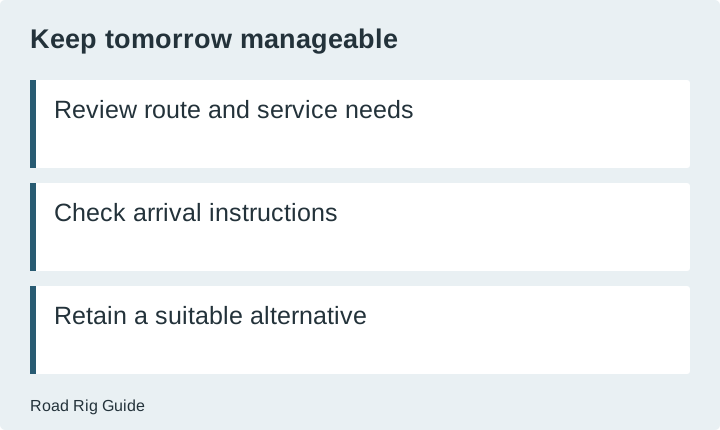
Close each day with tomorrow’s essentials
Review the next leg, the overnight status, and the tasks required before departure. Keep this review focused: route, service needs, arrival instructions, and any changed condition. A short reliable check is more useful than repeatedly rebuilding the whole week’s plan.
At the end of the trip, compare the itinerary with what actually happened. Record the driving and setup assumptions that were useful and the ones that were unrealistic. Those observations make the next trip more personal and evidence-based.
A successful first week is not measured by how many places appear on the route. It is a trip whose daily tasks, overnight arrangements, and alternatives you understand well enough to use. Leave room for the plan to improve as you learn the rig.
Sources
- NPS: finding and setting up a campsite
Accessed 2026-11-20. Check the source for equipment-specific instructions and current policies. - Recreation.gov: rules and reservation policies
Accessed 2026-11-20. Check the source for equipment-specific instructions and current policies.