What a loaded trailer weighs—and how to find out
Keep dry specifications, actual weights and ratings in separate columns.
Specs and limits
Dry specifications, actual loaded weight, axle readings, and rated limits are different values. Include the actual travel load and obtain measurements using a suitable procedure. No genuine weigh ticket is presented here; all numerical examples are explicitly hypothetical.
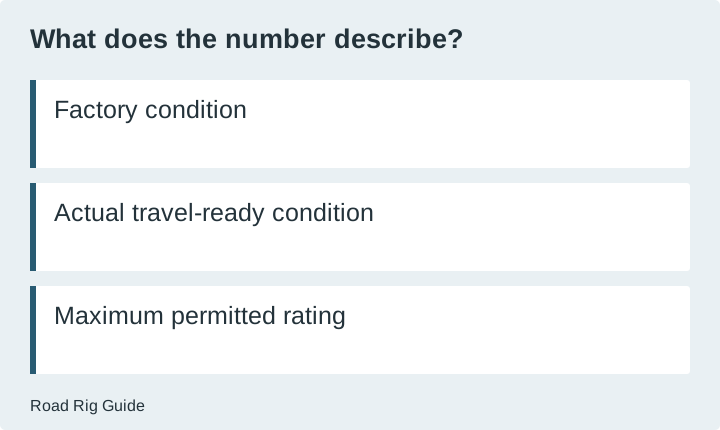
The weight printed in a brochure is not a record of the trailer you are about to tow. Food, clothing, equipment, water, accessories, and changes made after manufacture can alter the travel condition. Start by identifying what the published figure includes, then establish the actual loaded condition rather than guessing that the difference is small.
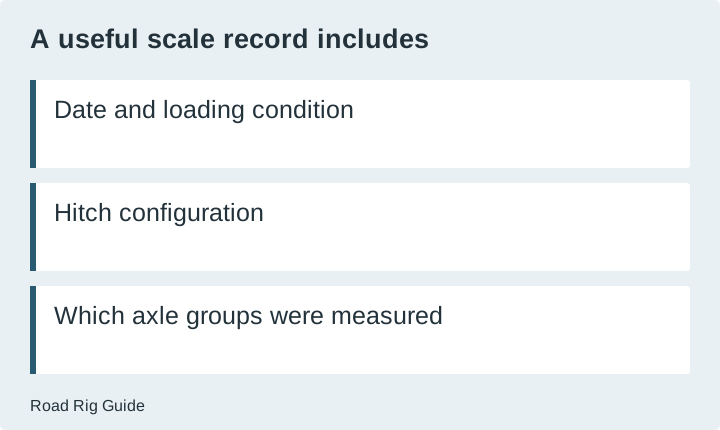
A useful weight record answers more than “How heavy is the trailer?” It says what was aboard, how the rig was connected, which axles or wheel positions were measured, and which ratings the readings were compared with. Without that context, even a real scale number can be misapplied.
Separate three kinds of number
The first kind is a specification describing a defined factory condition. Read its definition rather than assuming every manufacturer includes the same equipment and fluids. The second is an actual measurement of your loaded rig. The third is a rating that limits a particular vehicle, axle, tire, or component.
Do not substitute the third for the second. A trailer’s GVWR is not its measured current weight. Likewise, a remaining cargo allowance cannot be established accurately by subtracting an unrelated brochure value without understanding the specification and the actual changes to the unit.
Ford’s towing resources distinguish the ratings used when evaluating a combination. Use the documents for the actual tow vehicle and trailer. A generic model-family maximum cannot answer what your particular loaded combination permits.
Describe the travel condition
Make an inventory of what is normally aboard and identify anything that changes substantially between trips. Include occupants in the tow vehicle, hitch equipment, accessories, supplies, and the relevant tank conditions. The purpose is not to estimate every small object forever; it is to know what condition the weighing represents.
Record the equipment configuration as well. A changed hitch arrangement or added accessory may make an earlier measurement incomplete for the current question. Keep the date and identifying information with the record so you do not confuse tickets from different configurations.
If the intended trip load is not yet available, label preliminary estimates clearly. They may help decide what evidence to collect, but they are not a substitute for loaded measurements before relying on the combination. Avoid presenting a spreadsheet of estimated objects as a certified actual weight.
Plan the weighing with the operator
Use a facility and procedure suitable for the rig and the measurements needed. Ask the operator how the scale is used and follow its instructions. Do not improvise positioning, unhitching, or wheel-by-wheel methods in a location where they are not appropriate.
A complete hitched axle-group record can provide the front, rear, and trailer-axle totals for that state. Add all groups to obtain the combination total; add the vehicle groups for its hitched total. A separate whole-trailer or tongue/pin measurement requires an appropriate method and context.
Weight distribution changes how the combination carries load. Preserve the hitch state for each reading and do not mix readings from different states as though they were a single measurement. Obtain qualified guidance if the correct interpretation is unclear.
Label the records before doing arithmetic
| Record | What it represents | What it does not establish alone | | --- | --- | --- | | Factory specification | Defined original condition | Today’s loaded trailer weight | | Whole-trailer measurement | Actual trailer under stated conditions | Every axle or tire’s loading | | Hitched trailer-axle total | Load carried by those axles in that state | Whole trailer weight in every hitch configuration | | Tow-vehicle axle readings | Actual front and rear loads | All trailer component limits | | Combination total | Sum of all measured axle groups | Compliance with each smaller limit | | Tongue or pin measurement | Vertical load under the stated method | Universal suitability of the hitch arrangement |
This original table is a reading aid for your records, not a scale operating procedure. Keep the facility’s instructions and equipment manuals as the authority for obtaining the measurements safely.
Follow one hypothetical example
Suppose a complete hitched weighing gives 3,000 lb on the front axle, 3,500 lb on the rear axle, and 5,100 lb across the trailer axles. The measured combination total is 11,600 lb. The vehicle’s hitched total is 6,500 lb. You do not add tongue load again to those totals.
Suppose a separate appropriate measurement establishes the whole loaded trailer at 6,000 lb and its tongue load at 900 lb. Those example values can be entered separately into the towing worksheet. They do not mean every distributed hitch arrangement will show the same relationship between independent tongue weight and hitched axle-group readings.
All of these numbers are invented for explanation. They are not a scan or transcription of a real ticket and should not be used as a loading target. Replace them with actual measurements and the relevant ratings for your own combination.
Check the limits the total can hide
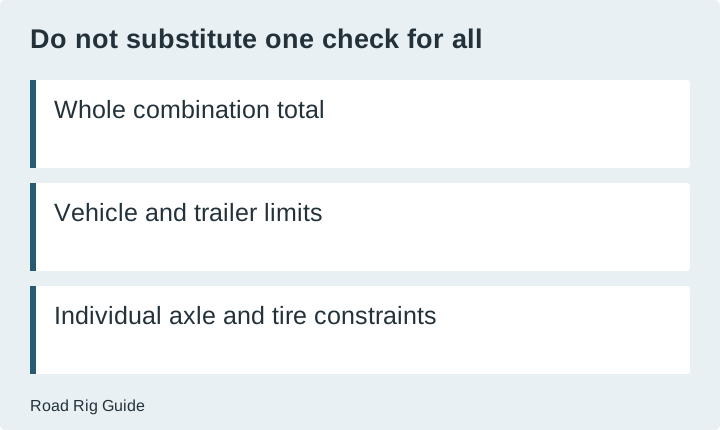
A combination total below GCWR does not guarantee that the rear axle, a trailer axle, or a tire is within its limit. Each relevant constraint needs the corresponding measurement. Do not treat extra allowance on one component as permission to exceed another.
NHTSA’s tire guidance explains the importance of tire information, inflation, loading, and condition. Use the correct vehicle and tire guidance for your equipment. This article does not calculate tire pressure or infer individual wheel-position loading from a favorable overall total.
If the available scale record does not provide a needed measurement, mark that check incomplete. Obtain an appropriate further assessment rather than manufacturing a balanced distribution in the spreadsheet. Real loading can differ from an assumption that both sides carry equal shares.
Use changes as a reason to review
A new battery, added cargo carrier, different hitch, or changed travel inventory can make an earlier result less useful. Record the change and assess whether fresh measurements are needed. Do not assume an old margin remains available after adding equipment.
Similarly, a ticket taken with a different tank condition or fewer occupants describes that earlier condition. Keep the context visible when planning a later trip. The fact that the vehicle itself is unchanged does not mean its operating weight is unchanged.
Use bookkeeping to identify likely changes, then use appropriate measurements to verify the actual combination. The two methods support each other when their roles are clear; problems arise when estimates are presented as measurements or measurements are detached from their conditions.
Keep the evidence usable
Store the scale record with the date, configuration notes, labels, and completed comparisons. Protect personal information if you share an image of a real ticket. Do not crop away the context that makes the record interpretable merely to produce an attractive illustration.
The final result should identify which limits were checked, which values came from measurement, and what remains unresolved. That record is more useful than a single loaded-weight claim and gives a qualified professional a clear basis for discussing the setup.
Sources
- Ford: towing and trailering resources
Accessed 2026-11-20. Check the source for equipment-specific instructions and current policies. - NHTSA: tire safety
Accessed 2026-11-20. Check the source for equipment-specific instructions and current policies.