Trip fuel cost: estimate it with towing mileage
Build a fuel budget from your actual route and a clearly stated MPG assumption, then check what changes when that assumption moves.
Specs and limits
Fuel cost equals total miles divided by US mpg, multiplied by the price per US gallon. The inputs must describe the same trip and use matching units.
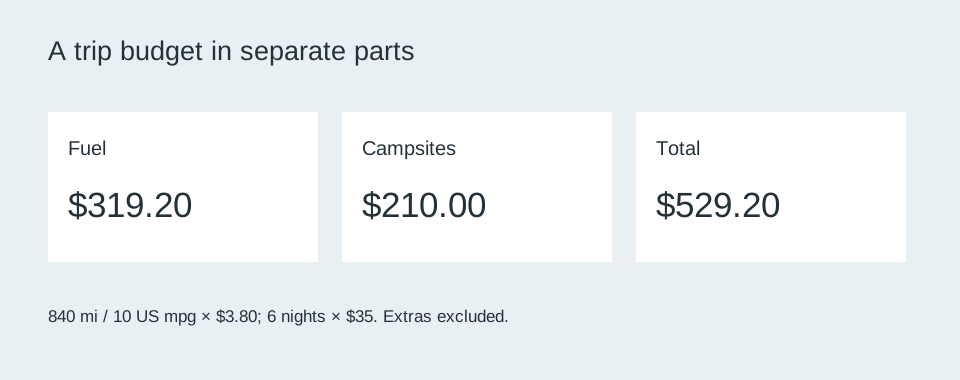
The example below assumes 840 miles, 10 US mpg, and $3.80 per US gallon: $319.20 in fuel. These are illustrative planning inputs, not current prices, test results, or a recommendation for your rig.
A fuel budget does not assess towing ratings, route clearance, or safe driving range. Check those separately using your equipment documentation and route information.
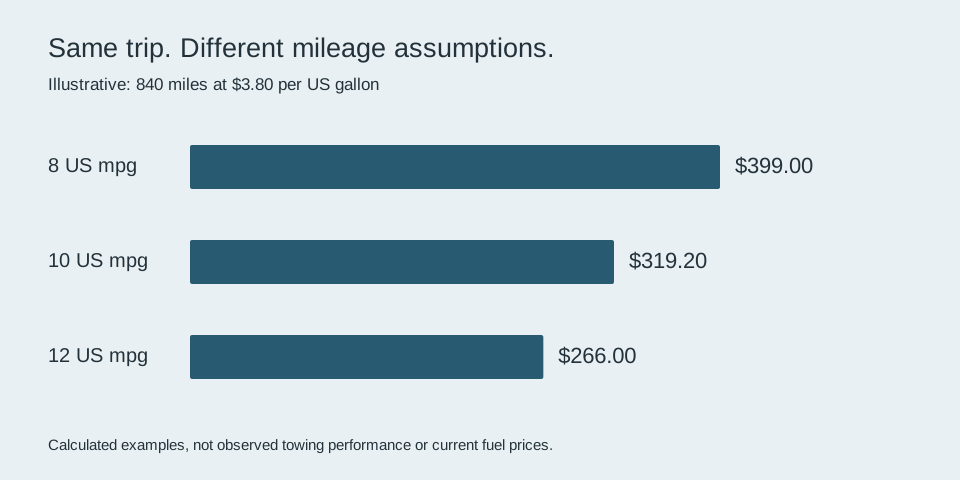
An 840-mile trip can have two quite different fuel budgets even when the route and pump price stay the same. At an assumed 10 US mpg and $3.80 per US gallon, the arithmetic gives $319.20. Change only the assumption to 8 US mpg and it becomes $399. That $79.80 difference is a useful reason to examine the mileage input before debating smaller expenses.
There is no universal towing-MPG number in this guide. The job is to make your assumptions visible, build a reasonable comparison, and avoid leaving out miles or mixing units. Use the trip fuel and campsite budget calculator as a worksheet while you collect the information. You can revise any input without changing the underlying method.
Count the driving you will actually do
Start with the complete journey, not the distance to the destination. Write out the outbound route, the return route, and planned driving between overnight stops. If the return follows a different road, count that leg separately. A loop trip is not necessarily twice the distance of its first leg.
Then decide what belongs inside this particular estimate. A tow vehicle may make local trips without the trailer while the trailer stays at camp. A motorhome may stay parked while another vehicle handles errands. You can calculate those miles separately when the fuel economy differs. Avoid putting all miles through one MPG input merely because it produces a tidy number.
Keep a small route ledger with a row for each segment and a note about what is still uncertain. If a campground has not been chosen, say so. A planned detour is a separate assumption, not an invisible percentage the calculator adds for you. The worksheet uses exactly the distance entered.
Choose a mileage assumption you can explain
If you have fuel records from a comparable loaded setup, begin there. Total miles divided by total US gallons gives the combined mileage for those records. Adding several individual MPG readings and dividing by the number of readings can be misleading when the distances differ. Work from the underlying miles and gallons whenever you can.
Compare like with like: the same tow vehicle and trailer, a similar load, and broadly similar driving. Those records still do not guarantee the next trip’s consumption. FuelEconomy.gov identifies towing, speed, terrain, and load as factors that affect fuel economy. An advertised highway rating should not quietly become a loaded towing estimate.
Without comparable records, use labeled scenarios. A baseline can help you begin, but an additional lower-MPG case reveals how much room the budget needs if that baseline is optimistic. The values in this guide are arithmetic examples only. They are not an observed range for travel trailers, motorhomes, or any particular truck.
Turn the assumptions into gallons and dollars
The first step calculates consumption: divide total distance by fuel economy. In our example, 840 miles divided by 10 US miles per gallon is 84 US gallons. The second step prices that consumption: 84 multiplied by $3.80 is $319.20. Nothing in those operations accounts for campground nights, meals, or road fees.
Keep the units attached while you work. “Gallons” is not precise enough when one source uses US gallons and another uses imperial gallons. Likewise, a price per liter cannot be substituted for a price per gallon. This worksheet uses miles, US mpg, USD per US gallon, and US dollars throughout.
The following table is calculated from the stated example inputs. It is not a price survey and does not identify a typical fuel economy. Its purpose is to show what changes when you vary one input and hold the others steady.
| Planning scenario | Distance | Assumed US mpg | US gallons | Fuel at $3.80/US gal | | --- | --- | --- | --- | --- | | Lower mileage | 840 mi | 8 | 105 | $399.00 | | Baseline | 840 mi | 10 | 84 | $319.20 | | Higher mileage | 840 mi | 12 | 70 | $266.00 |
Keep campsite costs on their own line
Fuel and overnight stays answer different questions. Fuel depends on distance, fuel economy, and price. Campsite cost depends on where you stay, which dates you book, and what the rate includes. Keeping separate subtotals makes it easier to see whether changing the route or changing the accommodation does more for your budget.
For a simple illustrative case, six nights at $35 add $210. Added to the $319.20 baseline fuel amount, that gives $529.20 before any other costs. A different number of nights changes only the campsite line unless it also changes your driving. Do not make that second change silently.
Recreation.gov’s reservation policies distinguish location-specific fees and booking conditions. Check the actual facility’s page and booking total. A displayed nightly rate is not proof that every applicable fee is included. Do not copy a fee from an unrelated campground and call it standard.
Compare alternatives one change at a time
Suppose you are weighing two campgrounds. One has a lower nightly rate but adds miles to the itinerary. Calculate the extra fuel from that added distance using the same MPG and fuel-price assumptions as the baseline. Compare the resulting amount with the campsite savings across the number of nights you will stay.
That is a useful comparison even without claiming either option is best. Check-in times, vehicle suitability, availability, and the experience you want may matter more than the small difference in dollars. The budget should make the cost tradeoff visible so the rest of the decision remains yours.
Similarly, test a higher fuel price separately from lower fuel economy first. If you change both immediately, you can see the combined effect but not which input drove it. Once you understand each one, combine them into an explicitly more expensive scenario if that helps you plan.
Write down the costs the tool cannot infer
Other expenses can include tolls, food, entrance charges, rentals, and a reserve you choose. None is included automatically. Generator fuel is also separate from driving fuel unless your own measurement and method deliberately account for it. Record the amount and reason for each extra rather than treating the final total as an all-inclusive trip price.
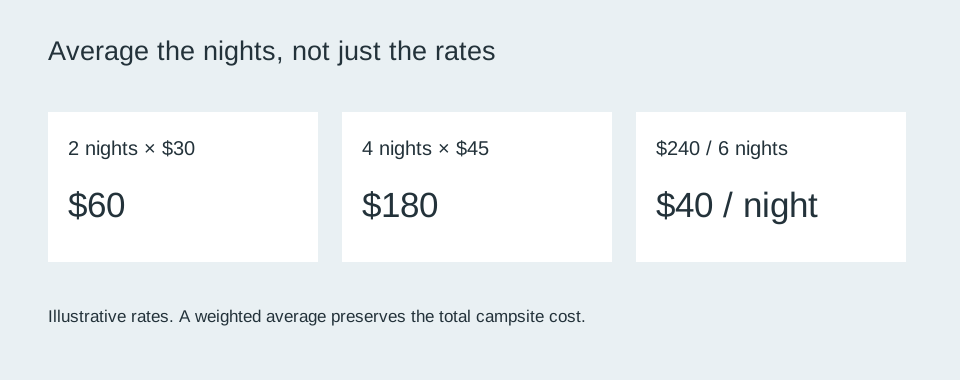
For mixed campsite rates, total the planned charges and divide by the corresponding nights. Two illustrative nights at $30 and four at $45 cost $240; spread across six nights, the average is $40. Entering six nights at $40 preserves the total. Entering the simple average of the two rates would not.
Leave with a baseline; return with better records
Before departure, save the route distance, mileage assumption, fuel price, campsite subtotal, and included extras. Mark which amounts come from confirmed bookings and which are estimates. That distinction makes an updated total understandable when a booking changes or a detour appears.
During the trip, retain the miles and fuel quantities needed to understand consumption. Afterward, compare the actual trip with the same categories in your starting plan. A difference can come from more miles, a different price, or different consumption; it is not automatically a mistake in the arithmetic.
The next estimate becomes more useful when it is grounded in those records. Until then, use the budget calculator to make uncertainty explicit. Keep equipment ratings and route suitability as separate checks, and treat every dollar figure here as a transparent planning result rather than a promise.
Sources
- FuelEconomy.gov — Many Factors Affect Fuel Economy
Accessed 2026-11-20. Check the source for equipment-specific instructions and current policies. - Recreation.gov — Rules and Reservation Policies
Accessed 2026-11-20. Check the source for equipment-specific instructions and current policies.