Cooler or 12V fridge: compare the runtime math
Put ice logistics and battery energy beside capacity and everyday convenience.
Specs and limits
Compare usable storage, trip length, resupply, and actual energy requirements. A refrigerator’s rated current is not automatically its average daily draw. Runtime depends on the measurement conditions and the usable battery energy available to all loads.
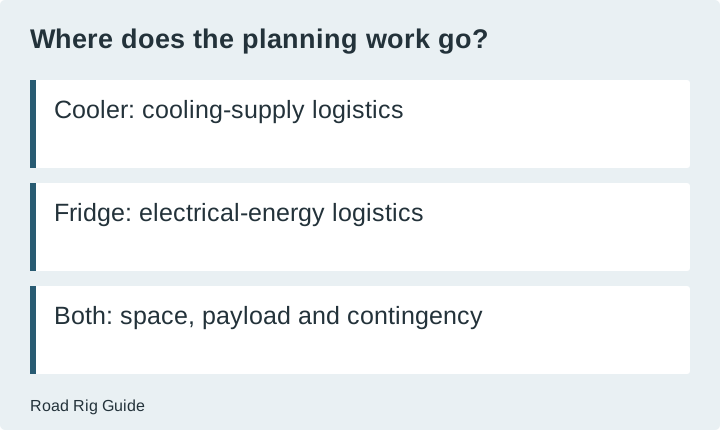
A cooler moves part of your planning problem into ice and resupply. A 12V refrigerator moves part of it into electrical energy and equipment compatibility. Neither eliminates the planning work. The useful choice depends on the trip, the space available, and how you intend to manage the supplies each system needs.
Start with the food-storage task and the actual number of days between reliable services. Do not select a refrigerator from a battery-capacity label alone or a cooler from an exterior volume figure alone. Compare the space you can use, what must be replenished, and what evidence supports the expected performance.
Compare the usable space
List the containers and items you normally carry. Check whether they fit through the opening and can be arranged so frequently used items remain accessible. Account for whatever cooling medium or internal compartments the chosen product requires. Exterior dimensions and nominal capacity do not fully describe the usable arrangement.
Consider where the unit will sit in the rig and how it will be secured according to its instructions. Check access to the lid or door in the actual travel and camping layout. A product can fit in a compartment while its lid cannot open conveniently or its required operating clearances cannot be met.
Keep payload in the comparison. Include the unit, its contents, and any additional equipment required for the plan. A powered option may also require changes to the electrical system, which need a separate qualified assessment. Do not assume an available socket establishes a suitable installation.
Put the resupply plan on paper
For a cooler, record where and when you expect to obtain the appropriate cooling supplies and how you will manage them using the product’s instructions. Do not assume every planned stop has the same supplies available. Keep a fallback plan if the expected service is closed or unavailable.
For a refrigerator, identify the sources expected to replenish the battery and the intervals between them. A solar panel on the roof is not a guaranteed daily energy amount. A drive day is not proof of a particular charge contribution. Use measured or properly specified system information when making that plan.
Keep food-safety decisions separate from the convenience comparison. This article does not provide food-storage temperature or time guidance. Use appropriate authoritative guidance and the appliance instructions for the food you carry rather than treating “still cool” or a working display as proof of safe storage.
Read consumption information correctly
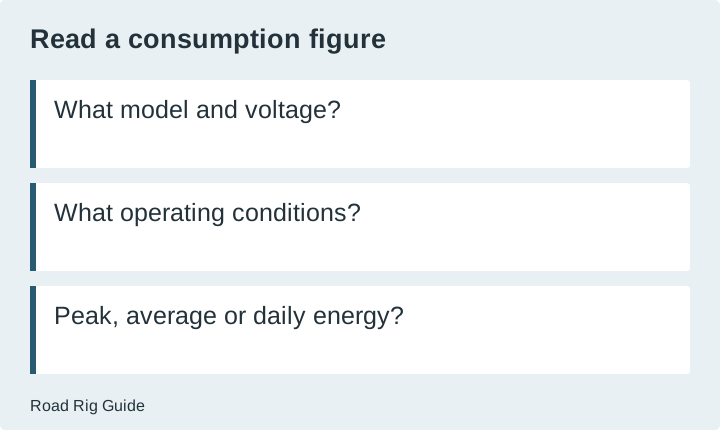
Dometic distinguishes rated current from energy consumption: consumption figures refer to defined ambient and internal temperature conditions. That is why a single current number cannot automatically be multiplied by a full day and described as observed daily use.
Dometic’s runtime explanation uses usable battery capacity and average consumption. For your own calculation, obtain the usable capacity from the actual battery documentation and operating plan rather than adopting a universal percentage for every battery chemistry.
Keep the test conditions beside the value. If your expected conditions differ, label the resulting runtime as an assumption and test alternatives. Opening patterns, set point, surrounding conditions, and the specific model all belong in the interpretation. Do not present a manufacturer’s controlled-condition value as a firsthand measurement of your trip.
Work through the energy units
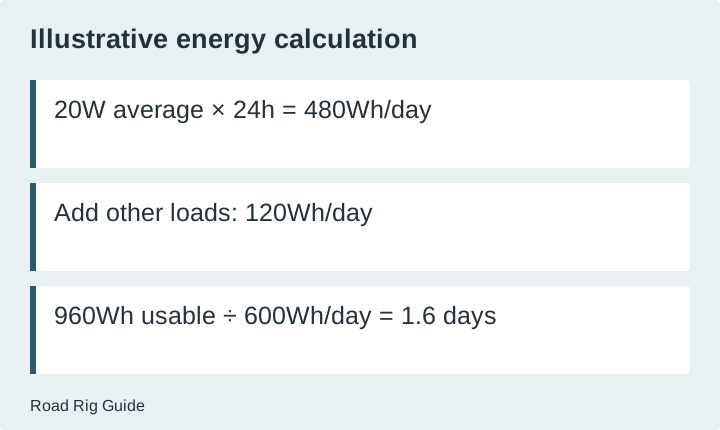
Suppose an illustrative refrigerator averages 20W over a day. Multiplying 20W by 24 hours gives 480Wh per day. This is a made-up example for unit arithmetic, not a specification for a particular product. If the available battery energy assigned to that load is 960Wh, the simple energy division gives two days.
Now suppose other loads consume 120Wh per day from that same available energy. The combined daily demand is 600Wh, so 960Wh divided by 600Wh gives 1.6 days. The refrigerator did not become less efficient; the first estimate incorrectly treated the whole battery as if no other equipment needed it.
The battery-sizing worksheet keeps those loads together. It separates direct-current loads, inverter-powered loads, and an idle allowance. It does not model every real-world battery effect or approve wiring. Use it to understand the arithmetic before discussing an installation with a qualified person.
Keep a side-by-side planning record
| Question | Cooler plan | 12V refrigerator plan | | --- | --- | --- | | Storage fit | Include cooling medium and access | Include internal arrangement and access | | Replenishment | Identify actual supply stops | Identify realistic charging opportunities | | Performance evidence | Product instructions and comparable records | Model consumption conditions and measurements | | Added equipment | Record all items needed | Record battery, charging and connection requirements | | Failure contingency | Plan for unavailable resupply | Plan for unavailable electrical energy | | Payload | Count unit, contents and supplies | Count unit, contents and added system equipment |
The table is not a product ranking. It shows where each option moves the work. Fill it with your own route and equipment information before deciding which inconvenience you would rather manage.
Distinguish running power from daily energy
A cycling compressor can draw a different amount while running than its average across a full day. You can model it using running watts and equivalent on-time, or using a measured average across the full period. Do not apply a duty-cycle reduction to an average that already includes cycling.
Peak demand and electrical compatibility also remain separate from runtime. A battery may hold enough energy for the calculated period but still be part of an unsuitable connection or system. Check the appliance and power-system documentation with the appropriate installer. This article provides no wire, fuse, or connector sizing instructions.
If a product specification uses amp-hours per hour at a stated voltage, retain that voltage and context when converting to energy. Avoid mixing a nominal 12V consumption figure with an unrelated amp-hour capacity as if the voltage were irrelevant. Watt-hours make comparisons clearer when systems differ.
Choose with a trial plan, not a promise
Before a longer journey, evaluate the arrangement under a manageable plan with a reliable fallback. Record actual energy or resupply use and the conditions. Do not describe this as a test result until it has genuinely been carried out and documented.
Use those records to revise the next trip’s assumptions. A cooler may suit a short route with convenient resupply; a powered refrigerator may suit another pattern if the electrical plan is adequate. Neither conclusion should be generalized beyond the conditions that support it.
The best comparison leaves you knowing what the system needs, where those needs will be met, and what happens when the plan changes. That is more useful than a headline runtime with no conditions or a claim that one option is always simpler.
Sources
- Dometic: calculating CFX3 power consumption
Accessed 2026-11-20. Check the source for equipment-specific instructions and current policies. - Dometic: rated current versus energy consumption
Accessed 2026-11-20. Check the source for equipment-specific instructions and current policies.