Size a 12V battery bank from a load audit
Count daily energy and simultaneous power before choosing capacity.
Specs and limits
Daily energy, usable capacity, continuous power, and startup demand are separate quantities. Use the actual battery’s voltage, discharge guidance, current limits, and temperature conditions. This is a planning audit, not a wiring or installation design.
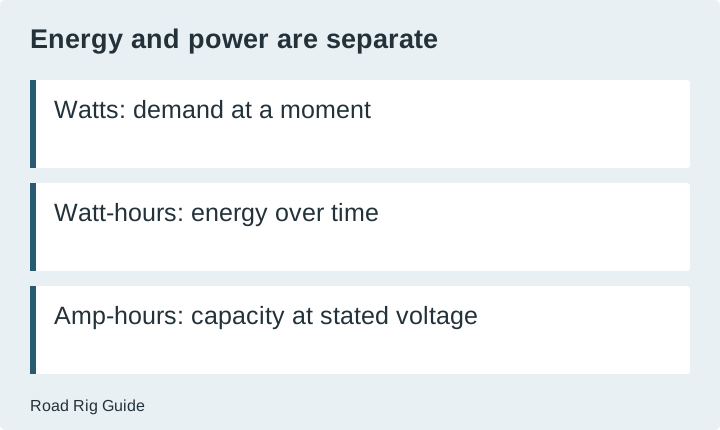
A battery-size question becomes much easier to answer when it starts with an appliance list. “Enough power for a weekend” is not a load specification. A weekend with lights and a refrigerator differs from one with inverter-powered cooking or other demanding appliances. Write down the work first, then calculate what it asks of the system.
The audit should expose uncertainty rather than hide it. Mark whether each value comes from a measurement, a product specification under stated conditions, or an assumption. That distinction tells you which input is worth improving before buying equipment.
Build a daily appliance ledger
List every load expected to draw from the battery. For each one, record the power source, running watts, expected operating time, and whether its demand changes through the day. Include small background loads and equipment that stays enabled between active uses.
Use a separate line for each appliance initially. Combining everything into one “miscellaneous” allowance makes omissions difficult to find. You can group loads later for a calculator with limited rows, provided you preserve the original daily energy and keep the detailed list.
Keep direct-current appliances separate from alternating-current appliances powered through an inverter. The AC appliance’s energy use is not the whole battery-side demand because the conversion has losses. Also distinguish a load that runs directly from shore power during a planned stay from one you expect to run from the battery.
Turn operating time into energy
Watts multiplied by hours gives watt-hours. An illustrative 40W load operating for six equivalent full-power hours uses 240Wh. The same 40W running value does not imply 960Wh per day unless it runs at that level for all 24 hours. Write the time basis beside the power figure.
For a cycling device, use running power and equivalent on-time, or a measured average over the full period. Do not reduce an average again for the same duty cycle. If a specification already provides daily energy under stated conditions, preserve that energy rather than forcing it into a misleading peak-current model.
Use a reasonable measurement method or the manufacturer’s documented information. Do not open electrical equipment or improvise connections to collect data. If the correct measurement is outside your competence, have an appropriate professional obtain it.
Add conversion and background demand
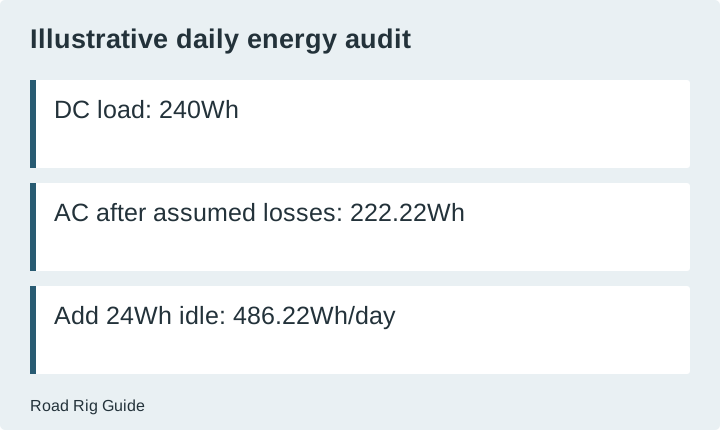
For an inverter-powered appliance, divide its AC watt-hours by the relevant efficiency fraction to estimate battery-side demand. For illustration, 200Wh at an assumed 90% efficiency requires about 222.22Wh from the battery. The efficiency is an explicit assumption, not a constant that applies to every inverter or load.
Add idle consumption separately where it is not already included. An inverter left enabled for long periods can consume energy outside the appliance’s active time. Keep that allowance on the battery side so it is not converted twice.
The battery-sizing worksheet uses this structure: DC energy plus adjusted AC energy plus the battery-side allowance. It gives a transparent estimate, not a simulation of voltage changes, temperature, aging, or every efficiency effect.
Keep an audit table with traceable inputs
| Load entry | Power basis | Time basis | Daily energy | Evidence needed | | --- | --- | --- | --- | --- | | Example DC load | 40W | 6 on-hours | 240Wh | Hypothetical arithmetic only | | Example AC load | 100W | 2 on-hours | 200Wh at appliance | Hypothetical arithmetic only | | AC battery demand | 90% assumed efficiency | Same usage | About 222.22Wh | Actual inverter data for a real plan | | Background allowance | Battery-side daily total | One day | 24Wh example | Measurement or relevant specification | | Example total | Sum after losses | One day | About 486.22Wh | All example assumptions retained |
The numbers are deliberately labeled as examples. Replace them with your actual loads rather than treating this table as a standard RV profile. A polished sample cannot establish how you personally use the equipment.
Decide what fraction of capacity to plan around
Nominal capacity and planned usable capacity are not interchangeable. Trojan’s lead-acid guidance discusses discharge depth in relation to battery use and life. Victron’s Lithium Smart data gives model-specific voltage, capacity, and operating conditions. Use the guidance for the actual product, not a chemistry label alone.
Enter nominal bank voltage and a supported planned discharge fraction. Do not assume every “12V” battery has the same nominal voltage or that every lithium product can use the same fraction under all conditions. Temperature, battery condition, current demands, and management limits can change the practical result.
A larger nominal bank is not automatically a compatible bank. Charging equipment, protection, installation requirements, and the rest of the system need review. This article does not authorize replacing one chemistry with another without that assessment.
Calculate autonomy without imaginary charging
Using the illustrative daily total of 486.22Wh, two days without replenishment require about 972.44Wh of usable energy. At an illustrative 80% usable fraction, nominal energy would be about 1,215.56Wh. At 12.8V nominal, that is about 94.97Ah.
This calculation assumes no charging contribution during those two days. If you plan to rely on solar or driving, build a separate evidence-based energy balance. Do not subtract a panel’s nameplate power as though it were daily energy, or assume every travel hour delivers a fixed amount to the battery.
Run a more demanding usage scenario and compare the result. Longer appliance time or a lower efficiency assumption can show which uncertainty matters most. Change one input at a time first so the cause of the difference remains clear.
Check power as well as energy
List the AC loads expected to run simultaneously. Their combined running power is a different quantity from daily watt-hours. A short high-power task can impose a substantial demand while adding relatively little energy to the day’s total.
Identify startup surge separately, including its duration and whether the stated value is total demand or additional demand above running power. The worksheet reports a running target with chosen headroom and a separate starting estimate. It does not choose an inverter from watts alone; VA, power factor, duration, and manufacturer limits may also matter.
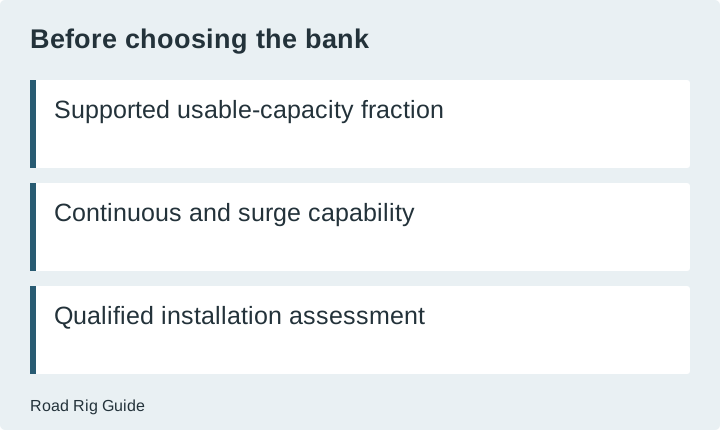
Battery and BMS current limits must also support the intended use. Enough stored energy does not guarantee adequate instantaneous delivery. Have a qualified installer assess the complete system rather than treating an amp-hour result as a finished electrical specification.
Keep the audit alive after the first trip
Compare the plan with actual records from ordinary use. Note changes in appliance time, conditions, charging opportunities, and equipment. Preserve the original assumptions so a difference can be explained rather than merely replaced with a new unexplained number.
Use the audit when discussing additions to the rig. A new appliance changes both the daily ledger and possibly the simultaneous-power requirement. Updating those two views before purchase is more useful than discovering the mismatch after installation.
A good load audit ends with a clear energy budget, a separate power-demand list, and an explicit set of installation questions. It narrows the capacity decision while leaving the technical work with the people and documents qualified to complete it.
Sources
- Victron Lithium Smart: technical data
Accessed 2026-11-20. Check the source for equipment-specific instructions and current policies. - Trojan Battery: lead-acid FAQs
Accessed 2026-11-20. Check the source for equipment-specific instructions and current policies.