Leveling blocks, chocks and stabilizers do different jobs
Identify the equipment’s purpose before deciding what your campsite setup needs.
Specs and limits
Leveling, preventing movement, and reducing rocking are different tasks. Identify each installed device and follow its own manual. Do not assume a stabilizer is a lifting jack, or that a product’s appearance establishes its capacity or correct placement.
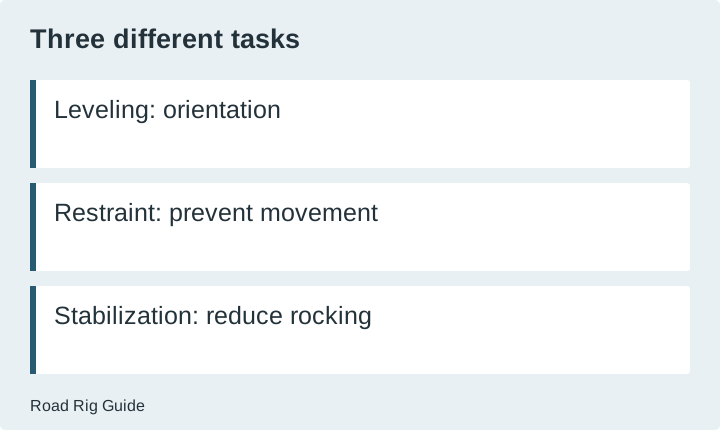
A trailer that feels steady is not necessarily level, and a level trailer is not necessarily secured against movement. Those distinctions matter when you are deciding what equipment to carry and which instructions apply at a campsite. Begin by identifying the problem you are trying to solve instead of treating blocks, chocks, and stabilizers as substitutes.
This is a concept guide for planning and equipment identification. It does not provide a universal setup sequence, lifting procedure, torque specification, or instruction to work beneath a trailer. The correct order and method depend on the RV and its installed equipment.
Give each task its own name
Leveling addresses the orientation of the RV. Movement restraint addresses the possibility of rolling or shifting. Stabilization addresses motion felt while the stationary RV is occupied. Equipment may serve one or more functions only where the manufacturer explicitly designs and approves it for that use.
The Jayco towable manual distinguishes stabilizers from leveling equipment and warns against using stabilizers as leveling jacks. That distinction applies to the described equipment; use your own manual to identify what is installed on your rig.
Lippert’s support library separates leveling systems, landing gear, stabilization, tongue jacks, and blocks into product areas. It is a useful place to locate documentation by product type, but the category page is not an operating procedure. Find the exact model before using instructions.
Inventory the equipment already installed
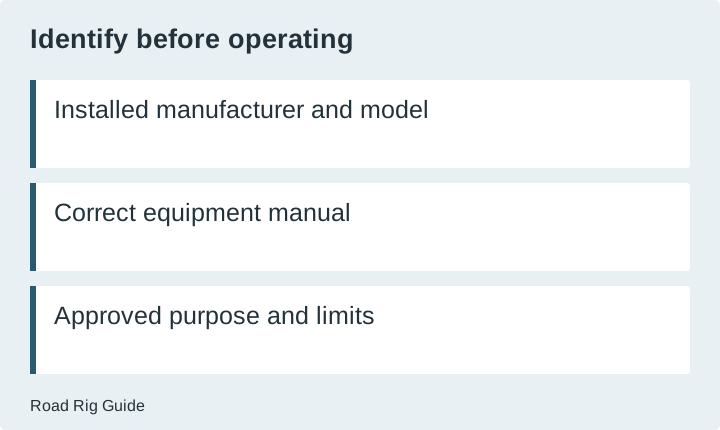
Record model identifiers and keep the corresponding manuals together. Include any owner-added parts and ask for documentation of changes. A previous owner’s nickname for a device is less useful than the manufacturer and model number on the actual equipment.
Note which controls operate which parts and ask a qualified person to demonstrate the normal sequence where needed. Do not test an unfamiliar control merely to discover what moves. A demonstration should follow the manual and the conditions required by the equipment, not a trial-and-error approach.
Also inventory loose equipment carried in storage. Check that pieces are identifiable and appropriate for the intended use. If capacity, condition, or compatibility cannot be established, treat the item as unresolved rather than assuming it is suitable because it came with the RV.
Use a task-to-document table
| Task | Equipment question | Document or observation needed | | --- | --- | --- | | Bring the RV to the required orientation | What leveling system or approved method applies? | Exact RV and equipment instructions | | Prevent movement | What restraint method is specified? | Correct product instructions and site assessment | | Reduce occupied rocking | Which stabilizers are installed? | Model identification and approved use | | Support a coupling-related operation | What jack or landing gear applies? | Equipment capacity and operating procedure | | Prepare for travel | What must be fully stowed and secured? | Manufacturer departure checklist |
This table is an original organization aid. It does not tell you where to place a device or how much load it can carry. Those are equipment-specific questions that require the actual documentation and suitable site conditions.
Assess the campsite before unloading equipment
Look at the available parking area and the space needed for the RV’s normal operation. If the site is unsuitable, consider another site rather than trying to overcome every problem with additional blocks or adjustment. Equipment has limits, and a convenient campsite location does not change them.
Check current campground instructions and ask staff about any uncertain condition or permitted use. The surface, slope, access, and available space can affect whether your planned setup is appropriate. A photograph from the booking page cannot replace what is present when you arrive.
Do not interpret this inspection as a direction to position people in a vehicle’s path or beneath supported equipment. Keep everyone clear of moving parts and follow the relevant safety instructions. If the situation requires unfamiliar judgment, obtain qualified help before continuing.
Understand why more force is not a solution
If the rig still moves after the normal procedure, do not assume the answer is to extend or tighten equipment further. The cause may involve the site, the equipment, or a misunderstanding of its purpose. Additional force can exceed a device’s intended use without resolving the actual issue.
Record what you observe and review the manual’s troubleshooting guidance. If the instructions do not explain the condition or the device appears damaged, stop using it and seek the appropriate support. A concept article cannot diagnose a structural or mechanical problem from a description.
The same restraint applies to adding improvised supports. Materials and stacking arrangements that appear sturdy may not be approved for the equipment or load. Use documented, compatible products and the specified method rather than copying a setup from an unrelated rig.
Plan storage and retrieval
The items needed early in setup should be accessible without unloading unrelated heavy gear. Decide where they will be stored and how they will be kept clean and secured for travel. Account for their actual mass in the rig’s loading plan rather than treating accessories as weightless conveniences.
The towing and payload worksheet can help organize added cargo and equipment mass, but it does not establish the capacity of blocks, chocks, or stabilizers. Keep those product ratings with their manuals. A favorable vehicle payload margin does not approve a particular support device.
After a trip, note which items were used and which problems remained. That record can guide a sensible equipment purchase. Buying more pieces without identifying the task can add weight and storage complexity while leaving the original issue unresolved.
Make the departure check explicit
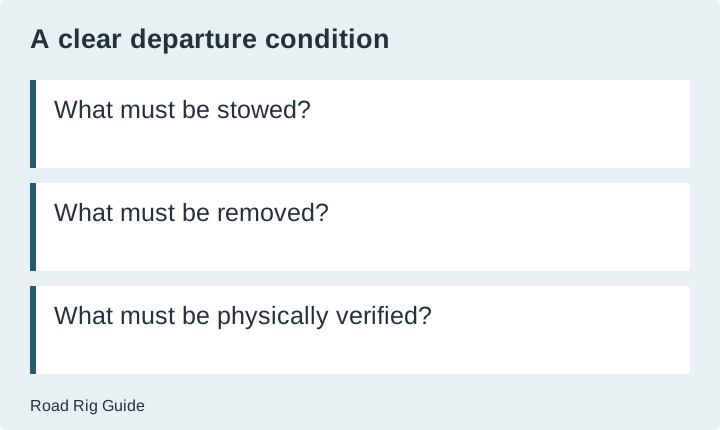
Add the installed system’s travel-ready condition to your departure list. Identify what must be retracted, removed, locked, or secured according to the manual. The check should refer to actual equipment names so another traveler can understand it without relying on your personal shorthand.
Confirm the physical condition, not merely that a control was operated. A button press and a completed movement are not the same observation. If the expected state cannot be verified safely, stop and resolve the issue rather than assuming it completed out of sight.
Use a consistent walkaround route and avoid dividing responsibility so vaguely that everyone assumes someone else checked the same item. A named task with a clear completed state is more reliable than a general instruction to “make sure the outside is ready.”
Keep the concepts separate in your notes
When discussing a concern with a service provider, describe whether it involves orientation, movement, rocking, or a device that does not operate as expected. Include the equipment model and what the manual instructed. That gives the provider a clearer starting point than saying the RV “needs better leveling.”
The practical outcome is a kit and procedure matched to the rig: each task has the correct device, each device has verified instructions, and the departure state is clear. No single accessory can substitute for that understanding, and no generic setup diagram should override it.
Sources
- Jayco 2026 family towable owner manual
Accessed 2026-11-20. Check the source for equipment-specific instructions and current policies. - Lippert: leveling and stabilization support
Accessed 2026-11-20. Check the source for equipment-specific instructions and current policies.