Hitch types: match the connection to the combination
Separate receiver, weight-distributing and fifth-wheel arrangements before checking ratings.
Specs and limits
Match the complete hitch system to the vehicle and trailer using their exact documentation. Gross trailer and vertical load ratings are different. A component rating, physical fit, or hitch-class label does not independently approve the combination.
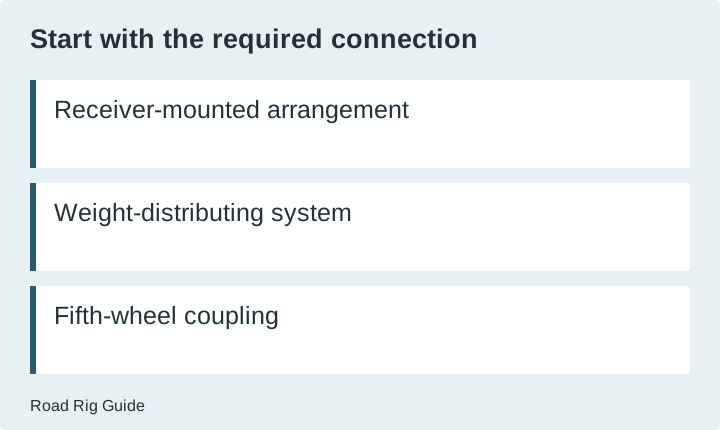
Before comparing hitch products, identify the connection the trailer and tow vehicle require. A receiver-mounted ball arrangement, a weight-distributing system, and a fifth-wheel coupling are not interchangeable ways to use the same rating. They organize the connection differently and bring different compatibility questions.
This guide explains the choices to investigate. It is not an installation, adjustment, coupling, or uncoupling procedure. Do not use it to choose fasteners, alter a frame, change a pin box, or fit an adapter. Those decisions require the exact equipment instructions and, where appropriate, qualified installation support.
Start with the two vehicles
Record the tow vehicle’s model, configuration, and installed towing equipment. Record the trailer’s coupling type and relevant ratings. Identify whether anything has been changed from the documented configuration. An owner-added component needs its own traceable specification and compatibility evidence.
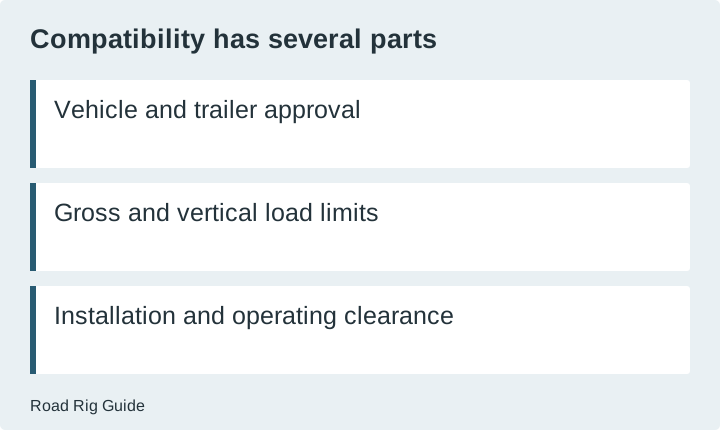
Ask which equipment the vehicle and trailer manufacturers require or permit. A product that fits a mounting point is not necessarily approved for the intended load or geometry. Keep fit, load rating, and operating compatibility as separate questions until each has a documented answer.
The first useful shortlist is therefore a shortlist of compatible systems, not a list sorted by the largest advertised capacity. A high-rated component cannot increase an unrelated vehicle or trailer limit. It may simply be more capacity than that component needs within an otherwise more restricted combination.
Receiver-mounted arrangements
CURT’s overview of hitch types describes receiver hitches and other coupling families. A receiver is one part of the connection. Other components, including the mount and coupling hardware, also need appropriate ratings and compatibility.
Record the gross trailer rating and the vertical load rating for the actual setup. If a label distinguishes different operating modes, retain those conditions. Do not copy one number while discarding the explanation attached to it. Missing or unreadable identification is an unresolved evidence problem.
When comparing products, ask the manufacturer or installer to explain the complete chain from the vehicle attachment to the trailer coupling. Your record should identify each relevant component and the lowest applicable limits, not just the product name most visible in the advertisement.
Weight distribution is a system question
A weight-distributing arrangement changes how load is shared through the combination. It does not remove mass from the rig or give permission to exceed the vehicle’s ratings. It must be compatible with the vehicle, trailer, receiver, and associated components and used according to the applicable instructions.
Do not select or adjust it from a generic percentage in an article. The correct procedure and verification depend on the equipment. A measured vehicle stance or a photograph is not, by itself, proof that axle loading and the installation are correct.
For budgeting and measurement, record the hitch system’s own mass and the configuration used during weighing. The towing worksheet keeps scale readings separate from payload bookkeeping. It deliberately does not instruct you how to tension or adjust a weight-distributing system.
Fifth-wheel connections and their questions
CURT’s fifth-wheel guide explains the coupling family and identifies pin load as a relevant load on the tow vehicle. The actual product and vehicle documentation are still needed to determine compatibility, capacity, and clearance for your specific combination.
Ask about the complete installed arrangement, including any rails, mounting system, pin-box configuration, and manufacturer-approved components. Do not assume an adapter is acceptable simply because it joins two shapes. Confirm that each affected manufacturer permits the arrangement and that the installation follows the required instructions.
Clearance is another separate question. The fact that a coupling can connect in a straight line does not establish appropriate movement clearance throughout operation. Have the relevant professional assess the actual combination rather than copying a solution from a truck with a different configuration.
Keep the comparison in a structured record
| Connection question | Record to obtain | Shortcut to avoid | | --- | --- | --- | | Coupling family | Vehicle and trailer requirements | Selecting by appearance alone | | Attachment compatibility | Exact approved product/application | Assuming a bolt pattern proves suitability | | Gross load | Lowest applicable rating in the chain | Using only the largest advertised number | | Vertical load | Correct tongue or pin rating | Treating it as the same as gross capacity | | Operating conditions | Required equipment and mode | Ignoring conditions printed with a rating | | Clearance | Assessment of the actual combination | Copying another vehicle’s arrangement | | Verification | Correct setup and inspection procedure | Declaring success from a level-looking photo |
This is an original question map, not a specification chart. Fill it with the manuals and records for the exact products under consideration. A blank row indicates the next question to resolve, not a reason to infer compatibility.
Account for the hitch in the loading plan
The hitch equipment itself can consume payload or cargo allowance, depending on the vehicle’s documented basis. Include added equipment once and keep its mass separate from the trailer’s tongue or pin load. A product described as lightweight still has a real mass that belongs in the plan.
For example, an illustrative 100 lb of added hitch equipment and a 900 lb measured vertical trailer load are two different entries. Combining them into one vague “hitch weight” field can make it unclear whether both have been included. This example explains bookkeeping only; it is not a typical hitch or trailer specification.
Use actual product data and measurements for the real combination. If a component is changed after weighing, review what that change means for the records. Do not continue using an old loading worksheet without identifying the changed equipment.
Know when the question needs an installer
Unclear mounting requirements, structural modifications, mismatched labels, or uncertain compatibility are reasons to consult the appropriate manufacturer or qualified installer. Do not solve them by drilling, welding, substituting hardware, or adapting instructions from another product.
The same applies to a system that behaves abnormally or shows damage. A buying comparison cannot determine whether it remains serviceable. Preserve the identifying information and observations so the provider can assess the actual equipment and its history.
Ask for documentation of the installed setup and the owner checks you are expected to perform. A useful handoff includes the correct manuals and a clear explanation of the normal operating and inspection responsibilities. It should not rely solely on remembering a brief demonstration.

Choose the documented fit
The final selection should answer why this system belongs on this vehicle with this trailer, what limits apply, and how correct installation and operation will be verified. Cost and convenience can then be compared among genuinely suitable options.
A hitch is part of a complete combination. Understanding its category helps you ask better questions, but the decision rests on exact equipment evidence. Keep the manuals, ratings, and installation records together so the next loading change or service visit starts from known facts.
Sources
- CURT: types of trailer hitches
Accessed 2026-11-20. Check the source for equipment-specific instructions and current policies. - CURT: fifth-wheel hitches explained
Accessed 2026-11-20. Check the source for equipment-specific instructions and current policies.