30A vs 50A shore power: what the rating changes
Understand service capacity and adapter limits without attempting mains electrical work.
Specs and limits
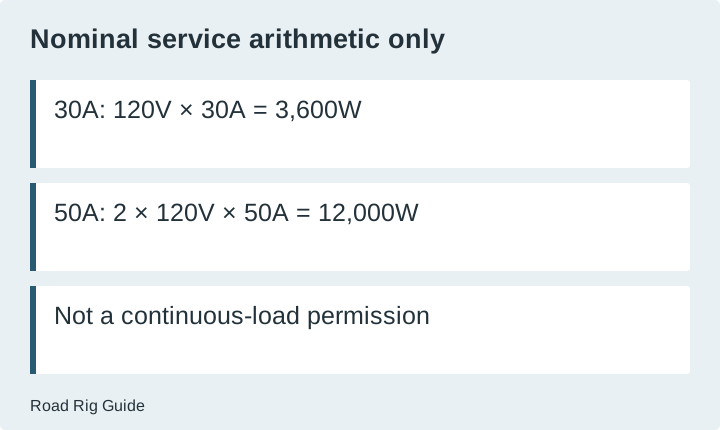
For the common North American RV services described here, 30A service has one nominal 120V leg; 50A service has two nominal 120V legs, each limited to 50A. These nominal comparisons are not a continuous-load allowance or a connection procedure. Use the RV’s exact instructions.
A campground listing that offers 30A or 50A power is describing more than two plug shapes. The available service and the RV’s distribution system determine what can be supplied, while individual circuits and appliances have their own limits. Start by identifying your rig’s documented service before deciding what a campsite listing means for it.
This article explains the concepts needed to ask better questions. It does not provide wiring, receptacle testing, panel access, adapter fabrication, or mains repair instructions. Uncertain or faulty electrical equipment belongs with the campground operator and an appropriately qualified technician or electrician.
Compare nominal service capacity carefully
The Jayco 2026 towable manual, electrical section, describes a 30A system with one 120V leg and a 50A system with two 120V legs. Multiplying nominal voltage and current gives 3,600W for the first comparison and 12,000W across the two legs for the second.
Those calculations explain why 50A service is not merely a modest increase over 30A service. They do not mean you should plan to run every circuit at its nominal maximum. Actual load planning must respect the applicable equipment ratings, circuit limits, operating instructions, and conditions.
The two-leg description also does not mean an individual appliance receives the combined capacity of both legs. The RV’s actual distribution and appliance requirements matter. Do not infer the voltage at a particular outlet from a general article about the service feeding the rig.
Use a concept table, not a wiring diagram
| Question | Common 30A RV service | Common 50A RV service | | --- | --- | --- | | Nominal supply arrangement described here | One 120V leg | Two 120V legs | | Current label | 30A total on that leg | 50A per leg | | Nominal arithmetic comparison | 120 × 30 = 3,600W | 120 × 50 × 2 = 12,000W | | What still limits a particular load? | Circuit and equipment ratings | Circuit, leg and equipment ratings | | Does an adapter create capacity? | No | No | | Who resolves an unsafe or uncertain connection? | Operator and qualified electrical professional | Operator and qualified electrical professional |
This is an original explanatory table based on the stated nominal service arrangements. It is not a diagram showing terminals, conductor placement, or a way to build a connection. Do not use it to identify an unknown receptacle by appearance.
Understand what an adapter does not do
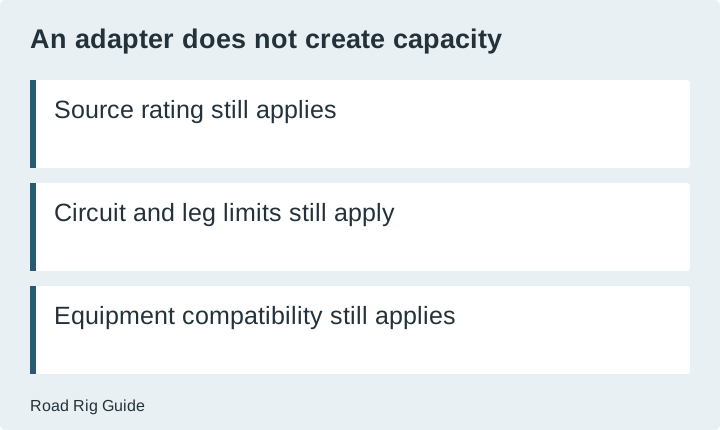
Southwire’s RV power guidance explains that a compatible 50A-to-30A arrangement remains limited by the 30A source. An adapter does not manufacture the missing service capacity. The complete equipment and connection must be appropriate for the application.
Do not assume a physically mating plug establishes correct voltage, grounding, condition, or compatibility. Use approved equipment and follow the actual RV, cord, adapter, and protection-device instructions. If the arrangement is unclear, ask a qualified professional rather than attempting to resolve it by trial.
An adapter also does not make a damaged cord or faulty pedestal acceptable. A protective device’s indication should be handled according to its instructions and the operator’s procedure. Do not bypass a warning or modify equipment to obtain power.
List simultaneous loads before booking
Make a practical list of the appliances you want to use at the same time. Record their documented electrical requirements and operating modes. A breakfast routine that combines several heating or cooking devices may have a different demand from a quiet evening with light use.
Do not confuse running demand with startup demand or average daily energy. A battery audit’s watt-hours tell you about energy over time, not whether a set of appliances can share a particular circuit at once. Keep these quantities in separate columns so each question is answered by the correct figure.
Ask which equipment the RV’s energy-management system controls, if one is installed, and what the manual requires when using a lower-capacity source. Do not invent a universal appliance combination that is guaranteed to work. Model, circuit arrangement, voltage, and operating conditions can differ.
Separate shore power from the battery system
Some RV functions use the DC system while others use AC supplies, and the installed converter, charger, inverter, or transfer equipment determines how those systems interact. Identify the actual components and their manuals before assuming which source powers a particular function.
The battery-sizing calculator estimates daily battery-side energy and selected AC power demands. It does not design a shore-power connection or determine whether an appliance is supported by your RV’s inverter. A working wall outlet while connected at a campground is not proof it will behave the same way away from shore power.
Record which operating mode you plan to use at each stop. This helps prevent counting the same appliance against a battery budget when it will use another source, or omitting it when you later change the camping plan. Keep the electrical installation assessment separate from this trip-level bookkeeping.
Ask the campground a precise question
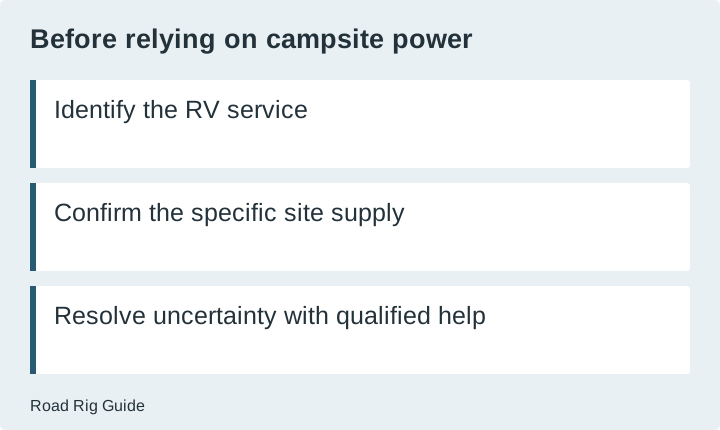
When booking, identify the service required by the rig and ask about the specific site offered. A property may advertise several service types without providing each type at every site. Retain the relevant confirmation and any operator instructions.
If a site differs from what was expected, contact the operator before improvising. Explain the RV’s documented service and the equipment you have, without assuming that a generic “RV outlet” description resolves the details. A clear question is more useful than trying to adapt an unknown supply.
Keep a suitable alternative plan if the required service is unavailable. That might mean changing the site or changing the trip arrangement within the equipment’s instructions. It should not depend on opening a pedestal, sharing unrelated outlets, or constructing a workaround.
Recognize the boundary of owner observation
You can record visible damage, an unusual condition, or a protection-device message without diagnosing the underlying fault. Preserve the exact message and equipment identity for the professional who will assess it. Do not turn repeated attempts into a troubleshooting strategy for mains power.
This guide does not describe how to test exposed electrical contacts or repair components. If the system’s safety instructions require disconnection or other action, follow those instructions within your competence and obtain qualified help. The purpose of understanding service ratings is to avoid unsafe assumptions, not to replace electrical training.
Keep the useful result simple
After reading the manuals, your planning record should state the RV’s service, the appropriate equipment, the site’s confirmed supply, and any load-management conditions. Keep unresolved questions visible before departure rather than discovering them during setup.
The central distinction is capacity versus compatibility. A larger nominal service can offer more capacity, but correct equipment and operating limits still govern the connection. An adapter may allow a supported arrangement, but it cannot turn the source into something it is not.
Sources
- Jayco 2026 family towable owner manual
Accessed 2026-11-20. Check the source for equipment-specific instructions and current policies. - Southwire: RV power FAQ
Accessed 2026-11-20. Check the source for equipment-specific instructions and current policies.