GVWR, GCWR, payload and tongue weight
Read each rating against the right measurement instead of relying on one towing number.
Specs and limits
Use ratings for the exact vehicle, trailer, and hitch configuration, plus travel-ready measurements. GVWR, GCWR, axle limits, payload, and hitch limits are separate constraints. Passing one does not establish compliance with the others.
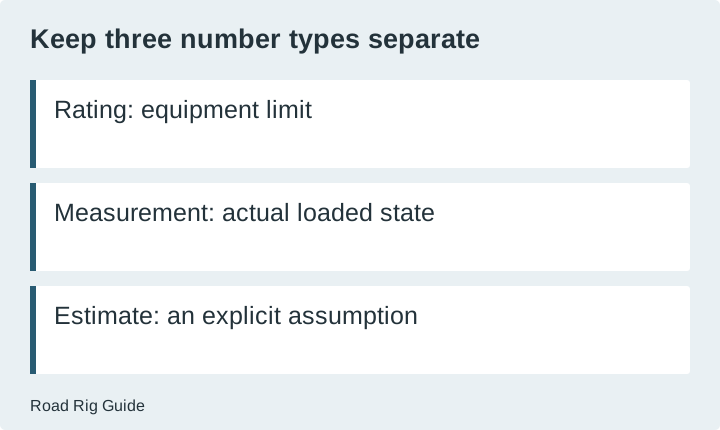
A towing advertisement usually emphasizes one large number. Your actual combination needs several smaller questions answered: how much the vehicle carries, how that load reaches each axle, what the whole combination weighs, and what every part of the connection permits. Start by separating ratings from measurements before subtracting anything.
A rating is a limit assigned to the equipment. A measured weight describes a particular loading condition. If you put a rated maximum into a field that expects an actual weight, the arithmetic can be neat and still answer the wrong question. Keep the source and meaning beside every value in your worksheet.
Read the labels as a set
Find the vehicle’s GVWR and axle ratings, its applicable payload information, and the trailer limit for the actual configuration. Then obtain the trailer’s ratings and the hitch-component limits. The Ford towing resource library provides model-specific references; it is not a substitute for identifying the correct vehicle and equipment.
Do not assume two vehicles with the same model name have the same allowable combination. Configuration and equipment matter. If a rating cannot be matched confidently to the vehicle, ask the manufacturer or an appropriate professional to resolve it before treating the number as established.
Keep photographs or transcriptions of the relevant labels with the manuals. Record units and any conditions attached to a rating. A value valid only with specified equipment should not be used as though it applies to every arrangement. The goal is a traceable set of limits, not the highest numbers you can find.
Match each rating to its measurement
| Limit | What it constrains | Measurement or record to compare | | --- | --- | --- | | Tow-vehicle GVWR | Loaded vehicle total | Actual vehicle axle totals in the relevant hitched state | | Front and rear GAWR | Each vehicle axle | That axle’s scale reading | | GCWR | Complete loaded combination | All combination axle readings from a consistent weighing | | Payload allowance | Added people and load under the stated allowance basis | Complete bookkeeping, checked against actual weights | | Trailer GVWR | Whole loaded trailer | Actual whole-trailer weight, not only its tires’ load | | Vehicle trailer limit | Trailer permitted by the vehicle configuration | Actual loaded trailer weight | | Hitch gross and vertical limits | Different loads on the connection | Whole trailer and measured tongue or pin load respectively |
The table is an original mapping aid. It does not establish a measurement procedure for every scale or hitch system. Use an appropriate weighing method and qualified help where needed to obtain the actual values safely.
Understand what payload bookkeeping includes
Payload is not reserved exclusively for the trailer. Passengers, luggage, accessories, and hitch equipment can all consume the allowance, depending on what is already included in the stated basis. Record each item once. If a modification is already reflected in a verified allowance, do not subtract it again without understanding that basis.
For an illustrative allowance of 1,700 lb, suppose passengers add 400 lb, cargo 200 lb, hitch equipment 100 lb, and measured tongue load 900 lb. The simple bookkeeping total is 1,600 lb, leaving 100 lb. These are hypothetical values, not a recommended loading pattern or a real vehicle specification.
That bookkeeping cannot show how the load is distributed across axles or wheels. A positive result therefore does not replace weighing. Treat a narrow or negative margin as a reason to investigate the complete setup, not as an invitation to omit a passenger or accessory from the worksheet.
Keep tongue weight out of the wrong sum
Tongue or pin load is part of how a trailer transfers load to the tow vehicle. If a complete hitched scale reading already includes that load on the vehicle’s axles, adding it again to those axle totals counts it twice. Conversely, looking only at the trailer axle group does not necessarily give the whole trailer’s weight.
Weight-distributing equipment can change the distribution among axle groups. Do not assume the relationship between a hitched trailer-axle reading and an independent tongue measurement is unchanged across different configurations. Keep the hitch state and loading conditions in the measurement record.
CURT’s hitch guide distinguishes connection types and their applications. Use the exact hitch manual for the required compatibility and setup procedure. This article explains bookkeeping boundaries; it does not provide hitch-adjustment instructions or a universal tongue-weight target.
Work through a scale-based example
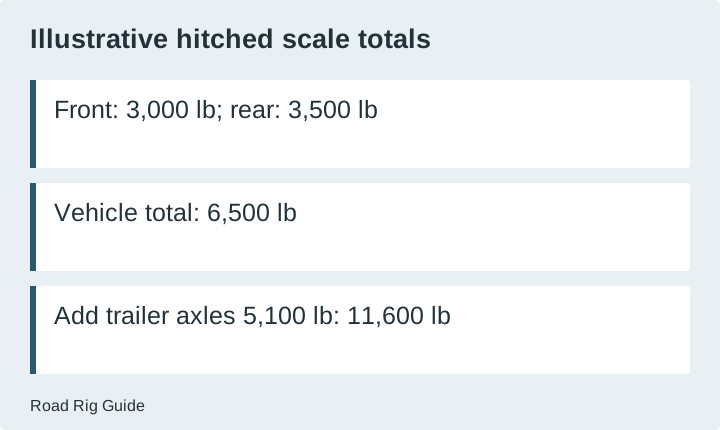
Assume a hypothetical hitched weighing records 3,000 lb at the front axle, 3,500 lb at the rear axle, and 5,100 lb at the trailer axle group. The tow vehicle’s measured total is 6,500 lb. The combination’s measured total is 11,600 lb. The tongue load is not added again to either sum.
If the example vehicle’s GVWR is 7,200 lb and GCWR is 15,000 lb, those two margins are 700 lb and 3,400 lb. With example front and rear axle ratings of 3,600 and 4,000 lb, the respective axle margins are 600 and 500 lb. Each subtraction answers a different question.
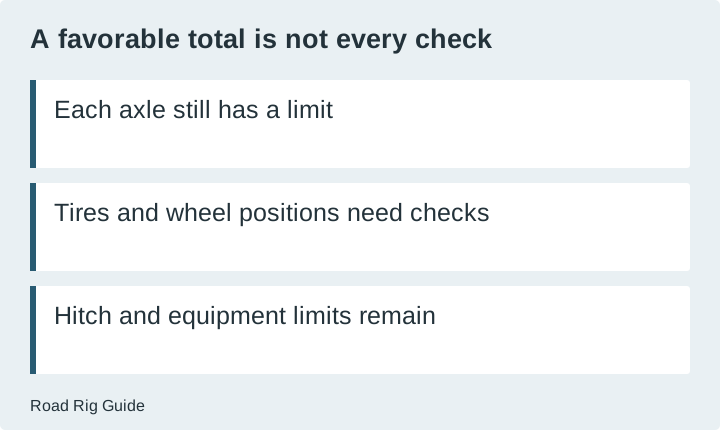
Now imagine the rear axle reading changes to 4,100 lb while the front stays at 3,000 lb. Vehicle total would be 7,100 lb, below the example GVWR, but the rear axle would exceed its example rating by 100 lb. This shows why a favorable total cannot cancel an exceeded axle limit.
Recognize what the worksheet omits
The towing check organizes the listed comparisons and reports exceeded entered ratings. It does not check every tire, wheel position, trailer axle, coupling detail, or operating condition. It also does not inspect brakes, suspension, hardware, or the quality of an installation.
A tire or individual wheel position can impose a limit that is not visible in an axle-group total. Manufacturer requirements for load distribution and operation also remain relevant. Do not interpret “no entered rating exceeded” as a completion certificate for the combination.
If measurements or ratings conflict, preserve the original records and ask for clarification. Do not silently choose the more convenient number or convert an unknown into zero. A calculator’s error message cannot identify the correct specification for equipment it has never inspected.
Recheck after the load changes
Keep a dated description of the travel condition with the weighing: occupants, supplies, tank state, accessories, and hitch arrangement. A later trip with materially different loading may need new measurements. A scale ticket is evidence of one condition, not a permanent property of the rig.
Use the record to answer a specific question about the current combination. Identify what is measured, what is rated, what is estimated, and what remains unchecked. That separation makes the numbers useful and prevents a single attractive towing figure from doing work it cannot support.
Sources
- Ford: towing and trailering resources
Accessed 2026-11-20. Check the source for equipment-specific instructions and current policies. - CURT: types of trailer hitches
Accessed 2026-11-20. Check the source for equipment-specific instructions and current policies.