How long will propane last on your trip?
Estimate appliance fuel use while keeping delivery capacity and safety checks separate.
Specs and limits
Runtime here means a fuel-energy estimate using available propane mass, appliance fuel-input ratings, and burner-on hours. It does not establish vaporization capacity, pressure, regulator sizing, or installation safety. No filling or gas-system repair instructions are included.
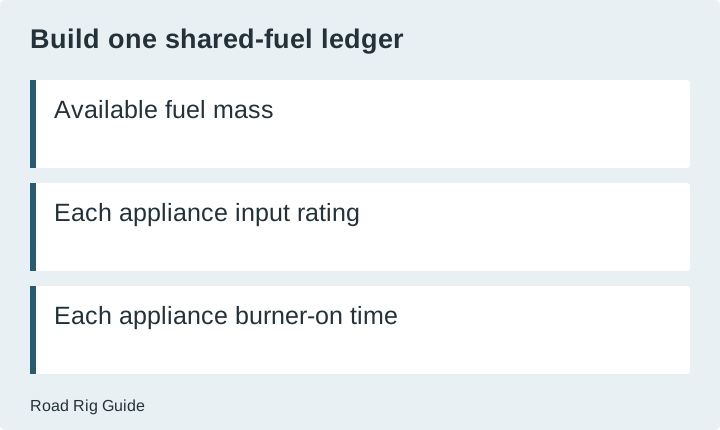
“How long will this tank last?” is missing two essential facts: how much propane is actually available and how quickly the appliances consume it. A nominal container size and a list of appliances cannot answer the question on their own. Begin with fuel mass and a daily use schedule, then make the uncertainty visible.
Heating, cooking, refrigeration, and water heating can share the same supply while operating on different schedules. Estimating each appliance against the entire container separately exaggerates the combined runtime. Build one daily consumption ledger for everything drawing from that supply.
Identify fuel quantity, not container weight
The relevant input is the mass of propane fuel available, excluding the container itself. A container’s empty weight, nominal size, and current contents are different quantities. Do not enter a gross weight or an assumed full quantity without understanding what the record represents.
Use reliable quantity information obtained appropriately for the equipment. This guide does not instruct you to disconnect, lift, fill, drain, or manipulate a propane system to obtain that number. If quantity cannot be established safely and confidently, seek qualified assistance or use a clearly labeled conservative planning assumption without presenting it as a measurement.
Decide whether part of the quantity should remain outside the estimate as a chosen reserve. Keep that decision explicit. A reserve is not a promise that the remaining fuel can be delivered under every condition, and this article does not prescribe a universally sufficient reserve amount.
Use input ratings rather than delivered heat
Find each appliance’s documented fuel-input rate. A heat-output figure describes a different quantity and cannot simply be inserted into the same formula. Keep units and the rating basis with the source so the calculation is traceable.
The PERC physical-properties reference hosted by DOE lists propane’s total heating value after vaporization as 21,548 BTU per pound. The worksheet uses that value solely for energy accounting. It does not adopt the publication’s autogas installation material as an RV procedure.
Ensure appliance inputs use a compatible heating-value basis. If the documentation is ambiguous, ask the manufacturer for the appropriate input figure. A precise constant cannot correct an appliance rating that answers the wrong question.
Estimate actual burner-on time
A thermostat-controlled appliance can remain enabled for many hours without burning continuously. Enter the equivalent time it operates at the stated input. Keep elapsed time and burner-on time separate so the same cycle reduction is not applied twice.
For a modulating appliance, use a documented equivalent average or model distinct operating periods. Do not invent a single universal duty cycle for a furnace or refrigerator. Conditions, settings, and equipment affect use, and the calculation does not predict those factors for you.
Record which energy mode each appliance uses during the planned stay. An appliance using another source should not also be assigned propane demand for the same period unless its actual operation requires both. Review the installed equipment’s instructions rather than assuming every model behaves alike.
Put the calculation in a table
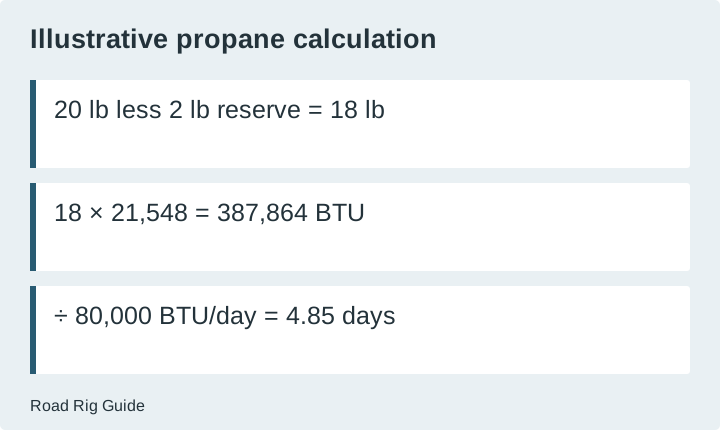
| Example input | Illustrative value | Meaning | | --- | --- | --- | | Available propane | 20 lb | Fuel only, not gross container weight | | Chosen reserve | 2 lb | Excluded from this example’s energy budget | | Included fuel | 18 lb | Available minus reserve | | Energy factor | 21,548 BTU/lb | PERC reference value | | Appliance input | 20,000 BTU/hour | Hypothetical fuel-input rating | | Burner-on time | 4 hours/day | Hypothetical equivalent daily operation | | Daily demand | 80,000 BTU/day | Input multiplied by on-time | | Estimated duration | About 4.85 days | 387,864 BTU divided by daily demand |
The table is an original worked example. It is not a claim about a particular furnace, weather forecast, or actual cylinder. Only the energy factor is sourced as a physical-property value; the other inputs are chosen to make the arithmetic visible.
Add the other appliances
Suppose a second hypothetical appliance uses 10,000 BTU per hour for two burner-on hours per day. It adds 20,000 BTU to the example’s daily demand, making 100,000 BTU per day. The same 387,864 BTU energy budget would then represent about 3.88 days.
This illustrates why shared supply matters. The first appliance’s individual runtime cannot be added to the second appliance’s individual runtime. Both consume the same finite fuel quantity, so their daily demands must be added before the division.
The propane runtime tool provides three appliance rows. If more consumers need representation, combine their daily input energy into an equivalent row and retain the detailed ledger. Do not combine unrelated quantities, such as one appliance’s rated input and another’s delivered output.
Separate energy sufficiency from delivery capability
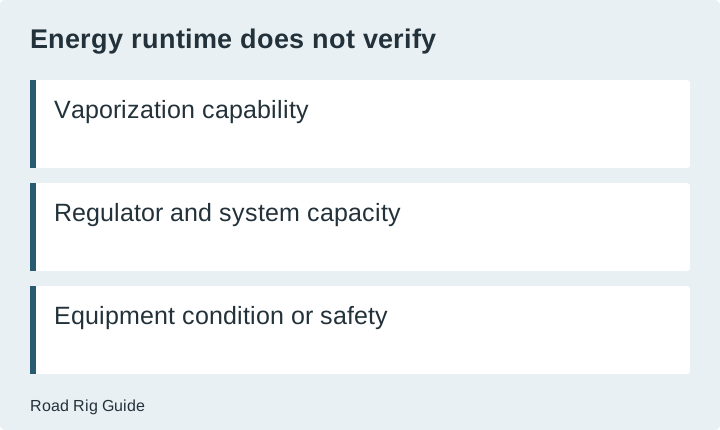
A fuel quantity can contain enough energy for the modeled period while the system still cannot supply the required instantaneous demand under the actual conditions. The runtime formula does not evaluate vaporization, pressure, regulator capacity, line sizing, or equipment condition.
The Jayco owner manual includes separate propane-system guidance and component instructions. Follow the documentation for your own RV and appliances. This planning article does not replace it or provide a method for modifying the system.
If an appliance malfunctions or a suspected leak or gas odor is present, follow the relevant emergency instructions and obtain appropriate help. Do not try to solve a potentially unsafe condition by changing calculator assumptions or manipulating gas equipment.
Use scenarios to expose uncertainty
Compare a baseline schedule with a more demanding one. For example, doubling the first example appliance’s burner-on time doubles its daily energy demand and halves its individual energy-based duration. That is arithmetic, not a prediction that a particular temperature change will double use.
Change one assumption at a time before combining several. This lets you see whether available fuel, operating time, or additional appliances have the largest effect. Keep the scenario name and inputs with the result so a later comparison remains understandable.
Do not present decimal days as a precise departure deadline. The tool displays a calculated value from uncertain inputs. A practical plan still needs reliable resupply, appropriate equipment, and a response if actual consumption differs from the model.
Improve the next estimate with records
Where quantity and use can be documented appropriately, compare planned and actual consumption after a trip. Record the appliances used, operating conditions, and any changes in the schedule. Do not infer a duty cycle from a single unexplained difference in remaining fuel.
Use the records to refine future assumptions, while keeping technical equipment questions with qualified providers. The useful outcome is a transparent consumption plan and a clear statement of what it does not establish. That is more dependable than a universal claim that a tank lasts a certain number of days.
Sources
- PERC 2011 propane physical-properties reference, DOE hosted
Accessed 2026-11-20. Check the source for equipment-specific instructions and current policies. - Jayco 2026 family towable owner manual
Accessed 2026-11-20. Check the source for equipment-specific instructions and current policies.